" It is new, indeed for I made it last night in a dream of strange cities: and dreams are older than brooding Tyre, or the
contemplative Sphinx, or garden-girdled Babylon" The Call of Cthulhu
Showing posts with label H.P. Lovecraft. Show all posts

Wednesday, November 2, 2022

Lovecrcraft, merchandising and me


My Mythos journey started at 15 when a friend lent me two books featuring these eerie portraits by John Holmes. (I did return his cpoies) My mother then gave me a copy of The Lurker at the Threshold with a somewhat funky cover by Murray Tinkelman, I am amazed to this day. (Sadly this is not that copy) One could note that two of the three books are primarily by August Derleth, but that is another post. However my love for HPL and the ever expanding mythos was launched. 

Lots of books followed including some of the less expensive Arkham House titles. But then other stuff appeared that did not require trips whether real, via mail or finally virtual to the haunts of used book sellers.


There is kids stuff.


There was science!! Sadly this site does not seem to update any longer but there are lots of fascinating posts.

https://lovecraftianscience.wordpress.com


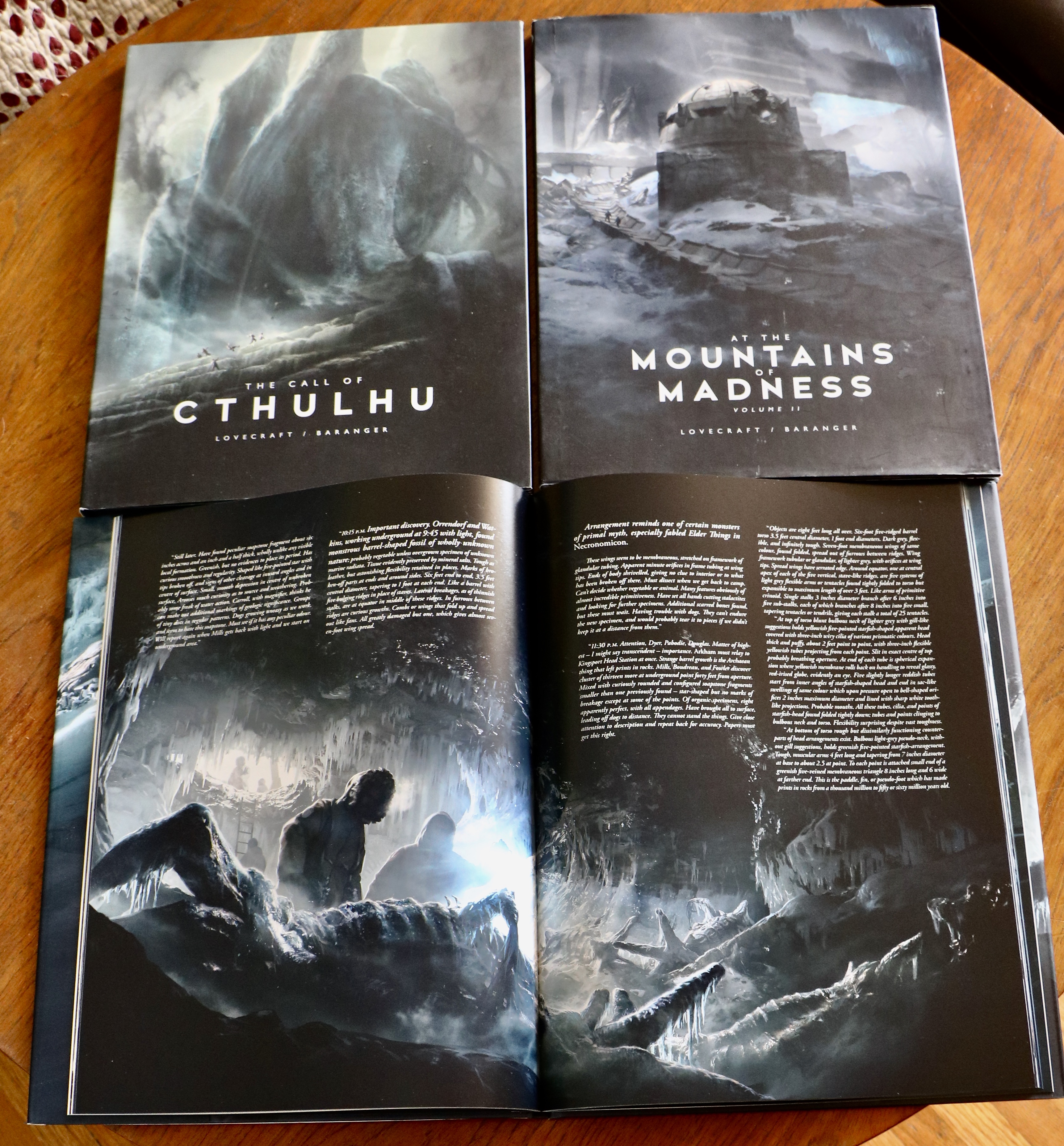
There are comics, graphic novels and these cool editions illustrated by Fracnois Baranger. Some have quibbled with his illustrations for example this depiction shows what might be a human skeleton in the cavern discovered by the member of the Miskatonic University Expedition to the Antartic. Maybe yes maybe no, but really people, why don't we call it foreshadowing and move on. These great books, great illustrations and I hope to discuss them in more detail in the future.

The there are games. My wife and I love collecting and sometimes even playing (actual physical) games. The more cool plastic figures and stunning graphics the better. And Howard is of course included.


Pandemic Reign of Cthulhu. It is produced by Z-Man games who produce a number of Pandemic games. You move around the world closing portals, and fighting cultists, monsters, and elder gods. It is the simplest and most compact of the mythos games we own. The game are relatively short and quite entertaining.

https://www.zmangames.com/en/products/pandemic-reign-cthulhu/


I cannot find my core box but as we can see Eldritch Horror has produced lots of expansions. Produced by Fantasy Flight games you fight, well you know.

 " An ancient evil is stirring. You are part of a team of unlikely heroes engaged in an international struggle to stop the gathering darkness. To do so, you’ll have to defeat foul monsters, travel to Other Worlds, and solve obscure mysteries surrounding this unspeakable horror. The effort may drain your sanity and cripple your body, but if you fail, the Ancient One will awaken and rain doom upon the known world. 


Eldritch Horror requires more space, takes longer and is more complex. There are a number of expansions including not just new opponents and scenarios  but in some cases additional boards. Great fun. 


Cthulhu Death may Die by CMON games. 

I purchased the base game and the larger Season 2 expansion at our local game store. The Black Goat of the Woods and Yog-sothoth expansions came from Amazon. CMON is currently running a kickstarter for another expansion Cthulhu Death May Die - Fear of The Unknown which has 7 days to go. We have ordered it, but I want to be clear, we are not involved with the company or the kickstarter campaign in anyway. We have purchased other games via kickstarter Wonderland Wars (Alice themed), Etherfields (Fantasy), ISS Vanguard (Space Exploration) and also have several more coming. What they have in common, is they take a long time to manufacture, cost a fair bit to ship and often during the course of the kickstarter you are seduced into adding things to the initial purchase like possibly an Ithaqua, the Wind-Walker, the Lord of the Winds expansion, or Animal Allies for when you are facing the Color Out of Space, but maybe that is just me.

We have never participated in a kickstarter from CMON games so I cannot speak to that. We like the Death May Die campaigns we have played. Like many modern games they take a fair bit of space to play, and have lots of elements to juggle. We also like the beautifully made miniatures that come with the game. Helen and I have both begun painting miniatures again, something we did close to forty years ago when we were first together, (then they were lead) and I plan on painting some of these. I was eyeing the Black Goat last night. Basically I love seeing models for Brown Jenkin (he is over sized so easier to paint) or a Gug or the stunning Tsathogguo figure. Also I am really enjoying seeing them incorporate beings from The Mound, Dreamlands and Lovecraft's story Hypnos. I am not encouraging anyone to purchase the game rather I think that people who like HPL and the Mythos might get a kick out of seeing all the associated tchotchkes. 

Monday, June 29, 2020

Valentia by Caitlin R. Kiernan.


Followers of this blog will know how much I enjoy the work of Caitlin R. Kiernan. The other day I decided to read her collection To Charles Fort with Love. I have a number of her collections on hand. But I decided on this one because both my wife and I enjoy the reality styling of Charles Fort, the author of (among other titles) The Book of the Damned. Fort collected and published accounts of "anomalous phenomena," things like rains of frogs, mysterious disappearances, lights in the sky etc. Helen has subscribed to The Fortean Times, a magazine devoted to Fortean occurrences for years. Many science fiction writers have been fans of Fort and Eric Frank Russell based several novels on ideas gleaned for Fort's books. So I was not surprised that Kiernan would assemble a collection in his memory. 

Valentia is a relatively short work. The protagonist Dr. Anne Campbell is a paleontologist working in New York. She receives a call from her supervisor(?) that a colleague Morris Whitney has been found dead in Ireland his body recovered by fisherman. She also learns that the site he was working on, the trackway of a tetrapod(s) early four-limbed vertebrates, has been damaged. Once in Ireland, Campbell means Marie, one of the two graduate students working with Whitney. Marie asks if Campbell was Whitney's lover, but Campbell says that part of their relationship ended a long time ago. Marie can offer no insights into by Whitney would have visited the site at night, or how his death may have come about, or who  would damage the fossils. The motive was not theft since nothing appears to have been removed. Instead, the fossils were smashed to pieces until nothing remains. The photographs, measurements and the data gathered on the scientific tests that were performed are still available, and Campbell begins to study them. That night Campbell has a dream in which she is standing on the step of the American Museum of Natural History. Suddenly Campbell finds herself transported back into a Devonian landscape similar to the one that would have existed when the fossil trackway was created. This dream of past landscapes is one she has experienced before, but this time it seems more disturbing, and at one point, she seemed to hear Whitney's voice. 


I enjoyed this story. Helen and I worked as archaeologists, and I have had a lifelong interest in prehistoric life. Kiernan herself has worked as a paleontologist specializing in marine life; mosasours and turtles seem to be two areas of interest. This experience allows her to bring a level of expertise to the story, including the description of Campbell's dream landscape. At the end of the story, Kiernan's notes mention that parts of this story were reworked for her novel Threshold. She also mentions that the trackway is real and that it was discovered in 1994 by Ivan Stossel. 


If you are interested in this evolutionary period, I recommend Your Inner Fish: a Journey into the 3.5 Billion-Year History of the Human Body by Neil Shubin. It was also a program on PBS. I took a look for the book downstairs, but I probably got it from the public library. I was able to find a theropod trackway photo, which might be the one Kiernan mentioned. Given our shared interests, Kiernan's story was one I found particularly interesting. 

Friday, February 14, 2020

"So Runs the World Away" by Caitlin R. Kiernan

  Much has been made of Lovecraft's cosmicism and rightly so. It is this aspect of his writing that set his work apart from that of the other Weird Tales writers of his generation and spawned countless pastiches, critical essays, polemics, stuffies and tchotchkes.

An aspect of his writing that gets less attention is his tales of a very puritanical witch-haunted New England. The doomed protagonists of his tales often find Margaret Murray'sThe Witch-Cult in Western Europe among the more 
eldritch tomes on the bookshelves they consult. Lovecraft himself offers us  the witch Keziah Mason and her familiar Brown Jenkin in "The Dreams in the Witch House".

"He was in the changeless, legend-haunted city of Arkham, with its clustering gambrel roofs that sway and sag over attics where witches hid from the King’s men in the dark, olden days of the Province." 1

The oft scorned figure of Cotton Mather stalks by the gallows hill and the graveyards holding the ancestors of still more doomed narrators.

"Beside the road at its crest a still higher summit rose, bleak and windswept, and I saw that it was a burying-ground where black gravestones stuck ghoulishly through the snow like the decayed fingernails of a gigantic corpse. The printless road was very lonely, and sometimes I thought I heard a distant horrible creaking as of a gibbet in the wind. They had hanged four kinsmen of mine for witchcraft in 1692, but I did not know just where." 2

"You call the Salem witchcraft a delusion, but I’ll wage my four-times-great-grandmother could have told you things. They hanged her on Gallows Hill, with Cotton Mather looking sanctimoniously on. Mather, damn him, was afraid somebody might succeed in kicking free of this accursed cage of monotony—I wish someone had laid a spell on him or sucked his blood in the night!


“I can shew you a house he lived in, and I can shew you another one he was afraid to enter in spite of all his fine bold talk. He knew things he didn’t dare put into that stupid Magnalia or that puerile Wonders of the Invisible World." 3


It is the modern version of this haunted New England that Caitlin R. Kiernan offers us in "So Runs the World Away" It is the story of the Dead Girl, her rival Gable, the boy Bobby, all of whom who live along the bank and in the waters of the Seekonk River. It is also the story of the strange house on Benefit Street, where the abnormally long-lived Miss Josephine holds forth on great disasters she has seen to her friends. A "rough circle of men and women that always makes the Dead Girl think of ravens gathered around carrion, blackbirds about a raccoon's corpse, jostling each other for the best bits" 4 It is also in the basement of the house on Benefit street that Madam Terpsichore instructs the younger ghouls in the correct away to dismember a corpse.

The Dead Girl and her companions move between both groups tolerated if not welcome. It is in the basement that the Dead Girl always seeking details of her past, quizzes the ghoul Barney about a strange vision of death she has had.

'I think I eat them," Dead Girl says. "But there are blackbirds then, a whole flock of blackbirds, and all I can hear are their wings. Their wings bruise the sky.' 5

But Barney refuses to tell her for fear of the reaction of the Baliff, a menacing figure who seems to exert a great deal of control over the group surrounding the Dead Girl. Later the Dead Girl takes a friend on a pilgrimage to Lovecraft's grave; a trip Kiernan must herself have made a number of times when she lived in Providence, Rhode Island.

To avoid spoilers, I will end my description of the story here. 
Having followed Kiernan's blog for years, I know she brings what seems like an encyclopedic knowledge of among other topics, Lovecraft's work, deep time, folklore, science, science fiction and horror to her tales. This knowledge includes film and music, as well as the written word. Like Lovecraft, she seems to visit a number of the sites she writes about as part of her research. And like Lovecraft, she often positions the fantastic elements of her stories within a network of real locations and events, quotations, newspapers clipping, and scientific facts. 

She also writes beautifully and evocatively.
"People have carved things," she says and strikes the lighter again, holds the flickering blueorange flame so that Adrian can see all the pocket-knife graffiti worked into the smooth, pale bark of the tree. The unpronounceable names of dark, fictitious gods and entire passages from Lovecraft, razor steel for ink to tattoo these occult wounds and lonely messages to a dead man, and she runs an index finger across a scar in the shape of a tentacle-headed fish." 6

I enjoyed the story; some may find ending is a bit ambiguous. I follow Kiernan's blog, and I seem to remember her mentioning that an editor of an anthology she was participating in complained that the conclusion of a story was ambiguous and rather than clarify it, she withdrew the story. I love that. I hate weird tales that offer too much explanation or even worse a prosaic explanation. I am mad for example, or in the case of William Hope Hodgson's worst Carnacki stories, criminals staged the entire haunting.

In their introduction to The Weird: A Compendium of Strange and Dark Stories,  Ann and Jeff Vandermeer quote Lovecraft on the weird tale.

"Instead, it represents the pursuit of some indefinable and perhaps maddeningly unreachable understanding of the world beyond the mundane – a ‘certain atmosphere of breathless and unexplainable dread’ or ‘malign and particular suspension or defeat of … fixed laws of Nature’ – through fiction that comes from the more unsettling, shadowy side of the fantastical tradition."

The Vandeermer's also state

"Because The Weird is as much a sensation as it is a mode of writing, the most keenly attuned amongst us will say ‘I know it when I see it,’ by which they mean ‘I know it when I feel""


They go on to say

"In either instance, subtle or bold, The Weird acknowledges that our search for understanding about worlds beyond our own cannot always be found in science or religion and thus becomes an alternative path for exploration of the numinous." 


For me, this is similar (not in content but impact) to the sense of wonder in science fiction. It is a point in which some aspect of the story transports my reading self out of the narrative into the realm of sensation or imaginative experience. And it is very much a matter of knowing it when I see it or rather experience it. The events within a weird tale are things of mood and atmosphere rather than something that can be categorized. They are very much experiences of the what (real or not).  What happened, what did I feel, what did I see, rather than how or why did something happened.

I read this in the PS Publishing collection of Kiernan's stories To Charles Fort 
With Love. It was followed by a discussion of the inspiration for the story and it's place within her body of work. I typed it while listening to the album Broadcast and The Focus Group Investigates Witch Cults Of The Radio Age, because I could. 

Caitlin R. Kiernan's Online Journal is here,


Footnotes

1 HPL, "The Dreams in the Witch House. "

2 HPL, "The Festival"

3 HPL, "Pickman's Model"

4-6 Kiernan, "So Runs the World Away"

Thursday, July 18, 2019

Robert Bloch; The Man Who Collected Poe and some links. July 19 one addition.


Weird Tales, October 1936, illustration by Virgil Finlay.

Last post I mentioned Robert Bloch's story "The Man Who Collected Poe" and the similarities between it and Lovecraft's story "The Case of Charles Dexter Ward". Before I move on to that story I thought it would be fun to look at the the posts of some other bloggers whose sites I enjoy and who also share a certain affection for the the works of H.P. Lovecraft as well as a few writers. If you know of any others I would love to expand this with another post. A great resource to find out what some of his friends and contemporaries felt about him is the Arkham House book Lovecraft Remembered.

http://www.isfdb.org/cgi-bin/pl.cgi?20871

Or… The Trials Of A Sort of Mythos Author. 

The jobbing writer knows no fear; accepts no shame. Literary purity is not for the likes of us, beggin’ yer pardon, guv’nor. Run off a young adult horror story? Index a quick textbook? Draft a missing cat advert? Write a Lovecraft Mythos story? Well, why not, given that you’re trying to earn a living? Was it not St Catherine of Alexandria who said “Better a sold Nyarlathotep story and a new gas cooker, than snobbery and half a box of matches.”? No, it wasn’t, but still…

http://greydogtales.com/blog/lovecraft-on-my-mind/


My obsession with the great Mr Howard Phillips Lovecraft
A few weeks ago I wrote an article in which I boldly stated that “I rarely buy the same book twice because a better cover comes along” and briefly mentioned my ‘vanity’ collection of H.P. Lovecraft titles. It’s true, I will buy anything bearing his name if it doesn’t already reside on my shelves, despite the fact that I may have several copies of the same volume under different covers. I just can’t help it, I don’t know exactly what spurs me on to indulge in this largely pointless endeavour apart from imagining myself as a custodian of sorts who seeks to amass and preserve these browning sheaves of paper from the ravages of time.

I bought my first set of Lovecraft anthologies back in 1985. They were published by Granada/Grafton and each of the four thick volumes bore the most garish cover imaginable which I have since traced back to an artist called Tim White. I was nineteen years old or thereabouts at the time and absolutely devoured their contents in a matter of weeks. I almost became one of Lovecraft’s impossibly driven characters poring over antiquarian manuscripts in a bid to find the arcane formula and sigils required to summon a foul, eldritch creature from its millennial slumber. I still have those books to this day – my ‘reading copies’ and they show surprisingly little in the way of ageing which is quite odd.

Teece’s Bit… A Shadow Over Rotherham


A few months ago, I suggested to my fellow vintage paperback collector and music aficionado Teece that he might pen a few articles for me to use on my blog. I’m very pleased to say that he accepted my invitation and so here is his first guest spot;
Harpers bookshop in the shadow of the imposing soot-encrusted church in Rotherham town centre was where I first got my unholy fix of science fiction and cosmic horror. The shop provided the haven of otherness which I craved as a teenager in the grim years of the early 1970s. Heading for those shelves bulging with creeping terrors and lurid futures, I felt I was transgressing… crossing a line that my parents, teachers and peers remained firmly the other side of. Just the sight of those weird and wonderful names on the book spines was enough to set my imagination racing – Philip K Dick, Cordwainer Smith, A. E. van Vogt, H. P. Lovecraft, Roger Zelazny, William Hope Hodgson, C. M. Kornbluth and the rest. It felt good to align myself with these literary misfits and malcontents in the shunned yet darkly fertile ghetto of ‘genre’ fiction. An escape from reality? Well no, this was the start of a journey into the deeper recesses of the human mind. These writers hold up a mirror – albeit twisted, warped and troubling! – to that strange and shifting place we call the real world.
As I neared the end of a story about a man foolish enough to venture upon the mist-laden moor alone I felt a dark presence looming over me. My heart froze and my gaze darted frantically to my left. Yes, Mr Vigil, my homeroom teacher, was standing next to me. He asked me what I was doing, I admitted my deed in a barely audible voice, and he asked if he could read it. I have often wondered what my life, or at least my writing life, would have been like if I had bucked authority (as was the fashion in the 60s) and said, "No way, man!" But I didn't, and he did read it, and I sat all sullen-eyed and brooded about the unfair vicissitudes of my life, and interfering teachers; toward the end of class, he handed back "The Moor" and said, surprisingly: "It was really good, and I'd like to read it when it's finished." And then he asked the question: "Have you ever read HP Lovecraft?" As it happened, I had not, but all that was about to change and my writing life take a big left turn.

In the introduction to her upcoming collection from Subterranean Press  Caitlin R. Kiernan provides a lovely reminiscence concerning her first experience with the works of H.P. Lovecraft
Lovecraft and I
Oh, where to start. 
"I’ll begin here, with the day I first encountered H. P. Lovecraft. Oddly,  I found him in Trussville, Alabama on a yellow school bus. I was seventeen years old."
Robert Bloch's experience was of course different, as Lovecraft was still alive at the time Bloch began reading his work.

"So, I wrote to Weird Tales and I wrote to Lovecraft in care of them to ask whether or not he knew where I could get some of these stories that I'd read about. He told me that he'd be glad to lend me any copies of any of his stories. So, we got into correspondence."


Cover by Don Punchatz

“The essential Saltes of Animals may be so prepared and preserved, that an ingenious Man may have the whole Ark of Noah in his own Studie, and raise the fine Shape of an Animal out of its Ashes at his Pleasure; and by the lyke Method from the essential Saltes of humane Dust, a Philosopher may, without any criminal Necromancy, call up the Shape of any dead Ancestour from the Dust whereinto his Bodie has been incinerated.” 

BORELLUS

As quoted in “The Case of Charles Dexter Ward”.

As I mentioned in my last post, Bloch’s "The Man Who Collected Poe" and Lovecraft’s "The Case of Charles Dexter Ward" both appeared in the Derleth anthology Night’s Yawning Peal

"The Man Who Collected Poe" begins;

“During the whole of a dull, dark, and soundless day in the autumn of the year, when the clouds hung oppressively low in the heavens, I had been passing alone, on horseback, through a singularly dreary tract of country; and at length found myself, as the shades of the evening drew on, within view of the melancholy House of Usher. 

I know not how it was — but, with the first glimpse of the building, a sense of insufferable gloom pervaded my spirit. I say insufferable; for the feeling was unrelieved by any of that half-pleasurable, because poetic, sentiment, with which the mind usually receives even the sternest natural images of the desolate or terrible. I looked upon the scene before me — upon the mere house, and the simple landscape features of the domain — upon the bleak walls — upon the vacant eye-like windows — upon a few rank sedges — and upon a few white trunks of decayed trees — with an utter depression of soul.” 

Oh wait, that’s the beginning of Poe’s “The Fall of the House of Usher”  Bloch begins thusly;

“During the whole of a dull, dark, and soundless day in the autumn of the year, when the clouds hung oppressively low in the heavens, I had been passing alone, by automobile, through a singularly dreary tract of country; and at length found myself, as the shades of the evening drew on, within view of my destination.

I looked upon the scene before me — upon the mere house, and the simple landscape features of the domain — upon the bleak walls — upon the vacant eye-like windows — upon a few rank sedges — and upon a few white trunks of decayed trees — with a feeling of utter confusion commingled with dismay. For it seemed to me as though I had visited this scene once before, or read about it, perhaps, in some frequently rescanned tale.” (66)

So we already know that while there might be some small nod to his friend Howard, Bloch is firmly in Poe territory here. 

The narrator has driven to the estate of Lancelot Canning to see his collection of material relating to the life and works of Edgar Allen Poe. The unnamed narrator met Canning at a recent bibliophilic meeting, and while his interest in Poe is mild at best, he has intrigued by Canning, who struck him as someone who might have stepped directly from one of Poe’s tales. As the valet guides him through the house, he is not disappointed the interior could also be lifted from Poe, and when he finally meets Canning he is reclining on a sofa in the library.
          As the tour begins Canning admits that the collection was begun by his grandfather, who collected first editions of Poe’s work and also was one of the group who had Poe reinterred to a more suitable spot. He also built the house, including a secret room with an iron door. Canning’s father expanded the collection. He specialized in the accumulation and study of Poe’s correspondence and also collected mementoes related to Poe and his family. While the two men talk they also seem to drink a great deal of wine and Canning opens up about the genesis of the collection, his own role in continuing to add to it, was well as some more intimate details concerning the special mania of the three generations of Canning men, when it came to Edgar Allen Poe. As far as the story goes I will leave you now.

But there are two connections to H.P. Lovecraft and his story “The Case of Charles Dexter Ward”. The narrator notes that the Canning collection contains De Vermis Mysteries a tome that Bloch himself added to the mythos bibliography in his short story "The Shambler from the Stars" , and the Liber Eibon which was added by Clark Ashton Smith and mentioned in his short story  "Ubbo-Sathla". (75) The term essential salts also appears. (77)

As excellent resource for figuring out which forbidden books appear in which mythos stories can be found at;

As part of this exercise I reread “The Case of Charles Dexter Ward”, and I wanted to make a few general comments. Ward’s love of his city, Providence and the New England setting, really reminded me in a passage in "The Dream-Quest of Unknown Kadath" and Randolph Carter’s love for Boston and New England. 

from "The Case of Charles Dexter Ward".

“His home was a great Georgian mansion atop the well-nigh precipitous hill that rises just east of the river; and from the rear windows of its rambling wings he could look dizzily out over all the clustered spires, domes, roofs, and skyscraper summits of the lower town to the purple hills of the countryside beyond. Here he was born, and from the lovely classic porch of the double-bayed brick facade his nurse had first wheeled him in his carriage; past the little white farmhouse of two hundred years before that the town had long ago overtaken, and on toward the stately colleges along the shady, sumptuous street, whose old square brick mansions and smaller wooden houses with narrow, heavy-columned Doric porches dreamed solid and exclusive amidst their generous yards and gardens. He had been wheeled, too, along sleepy Congdon Street, one tier lower down on the steep hill, and with all its eastern homes on high terraces. The small wooden houses averaged a greater age here, for it was up this hill that the growing town had climbed; and in these rides he had imbibed something of the colour of a quaint colonial village. The nurse used to stop and sit on the benches of Prospect Terrace to chat with policemen; and one of the child’s first memories was of the great westward sea of hazy roofs and domes and steeples and far hills which he saw one winter afternoon from that great railed embankment, all violet and mystic against a fevered, apocalyptic sunset of reds and golds and purples and curious greens. The vast marble dome of the State House stood out in massive silhouette, its crowning statue haloed fantastically by a break in one of the tinted stratus clouds that barred the flaming sky."

from "The Dream-Quest of Unknown Kadath"

“For know you, that your gold and marble city of wonder is only the sum of what you have seen and loved in youth. It is the glory of Boston’s hillside roofs and western windows aflame with sunset; of the flower-fragrant Common and the great dome on the hill and the tangle of gables and chimneys in the violet valley where the many-bridged Charles flows drowsily. These things you saw, Randolph Carter, when your nurse first wheeled you out in the springtime, and they will be the last things you will ever see with eyes of memory and of love. And there is antique Salem with its brooding years, and spectral Marblehead scaling its rocky precipices into past centuries, and the glory of Salem’s towers and spires seen afar from Marblehead’s pastures across the harbour against the setting sun. “There is Providence, quaint and lordly on its seven hills over the blue harbour, with terraces of green leading up to steeples and citadels of living antiquity, and Newport climbing wraith-like from its dreaming breakwater. Arkham is there, with its moss-grown gambrel roofs and the rocky rolling meadows behind it; and antediluvian Kingsport hoary with stacked chimneys and deserted quays and overhanging gables, and the marvel of high cliffs and the milky-misted ocean with tolling buoys beyond. “Cool vales in Concord, cobbled lanes in Portsmouth, twilight bends of rustic New-Hampshire roads where giant elms half hide white farmhouse walls and creaking well-sweeps. Gloucester’s salt wharves and Truro’s windy willows. Vistas of distant steepled towns and hills beyond hills along the North Shore, hushed stony slopes and low ivied cottages in the lee of huge boulders in Rhode-Island’s back country. Scent of the sea and fragrance of the fields; spell of the dark woods and joy of the orchards and gardens at dawn. These, Randolph Carter, are your city; for they are yourself. New-England bore you, and into your soul she poured a liquid loveliness which cannot die. This loveliness, moulded, crystallised, and polished by years of memory and dreaming, is your terraced wonder of elusive sunsets; and to find that marble parapet with curious urns and carven rail, and descend at last those endless balustraded steps to the city of broad squares and prismatic fountains, you need only to turn back to the thoughts and visions of your wistful boyhood."

Lovecraft returned to Providence from his years in New York in 1926 and his return coincided with the production of his most significant works. “The Color out of Space” (1927), “The Call of of Cthulhu (1928), “The Dunwich Horror” (1929). The Whisperer in Darkness (1931) etc. “The Dream-Quest of Unknown Kadath" was begun in 1926 and completed in 1927 and “The Case of Charles Dexter Ward” in 1927. From the passages I quoted it is I think possible to see them as including, despite the horror in “The Case of Charles Dexter Ward”, a loving invocation to Lovecraft’s own childhood and his ongoing admiration for the landscape of New England. Among the longest works Lovecraft had produced up until this time, and unpublished during his lifetime, it is interesting to speculate how a positive reception for one or both works might have changed Lovecraft’s subsequent career. 

Thursday, July 11, 2019

New Arrivals


It is funny how I now tend to create the same environment around me wherever I spend much time. Now at least these few shelves at the cabin look very much like my shelves at home crammed with science fiction and mythos related items with the covers of the more striking paperbacks and chapbooks displayed so I can enjoy them at a glance.

As I have mentioned previously on this website, my collecting, as opposed to just accumulating books to read began with H.P. Lovecraft's books and other Arkham House publications. While I did not aspire to first edition copies of The Outsider and Others or Beyond the Walls of Sleep, I did get a lovely The House on the Borderlands by William Hope Hodgson (with a Hannes Bok dust jacket) and a copy of Derleth’s Lurker on the Threshold with Oswald Train’s (an early science fiction publisher) bookplate. One thing I now regret is I traded in a number of my original Lovecraft paperbacks as I got hardcovers. Eventually, I collected more widely, expanding to small press science fiction and magazines. But now having a lot of books I find I enjoy collecting paperbacks, a less pricey and bulky segment of the publishing industry. And while I had been looking at some UK science fiction editions, my latest purchases as often happens, brought me back to Howard yet again.


A couple of years ago I had the chance to spend $300 on the Arkham House edition of The Mask of Cthulhu with a beautiful dust jacket by Richard Taylor. I passed and now I love my Consul edition (1961) with a sadly unattributed cover.


I really enjoy Darrell Schweitzer’s mythos tales as well as his essays and the anthologies he puts together. I could not resist this Starmount Press book Discovering H.P. Lovecraft (1987) with a cover depicting Randolph Carter as the wizard Zkauba of the planet Yaddith, (Through the Gates of the Silver Key). Cover by Richard Huber. Also appeared as Essays Lovecraftian.


Brian Lumley seems to get some criticism in the Mythos community, I suspect because much of his work is seen as more closely related to August Derleth’s additions to the mythos than the Lovecraft canon. While I think his Titus Crow adventures continued too long and morphed into more action-adventure stories than mythos tales, he has contributed a lot of solid work. I hope to look at his stories more closely in the future. Cover by Les Edwards, New English Library, 1995.


I cannot resist a Derleth anthology with a cover featuring wolves with coral snakes for tongues, thanks to Don Punchatz. This collection includes “The Man Who Collected Poe” by Robert Bloch, a story I had not read before and “The Case of Charles Dexter Ward” by H.P. Lovecraft. I had not realized there was a connection between these tales before but I  hope to provide more detail regarding this in my next post. 


And my shelves always have room for another Bradbury, cover and interior illustrations by the incomparable Joseph Mugnaini.

Full wraparound cover.

http://www.isfdb.org/cgi-bin/pl.cgi?226697

Thursday, May 23, 2019

Thomas Ligotti; more links

I have encountered several resources that I would like to share. The first is an essay on Ligotti and Lovecraft by Matt Cardin. Cardin provides a very concise discussion of the lives and works of both authors and then takes a detailed look at similarities and differences in both author's worldview and how this influences their writing. I found this quite informative. I have always found the connection between the works of Ligotti and Lovecraft when considered in their entirety overstated. Some works like Ligotti's "The Last Feast of the Harlequin" and "The Sect of the Idiot" have an obvious connection but as Cardin rightly points out the differences between the two authors works or personal philosophies are far more important in understanding their works than any similarities. This point is also reinforced in the Weird Studies podcast below.

The Masters' Eyes Shining with Secrets:
H.P. Lovecraft and His Influence on Thomas Ligotti by Matt Cardin

from the introduction
"Jonathan Padgett, the originator of Thomas Ligotti Online, relates the following anecdote in his Ligotti FAQ: "In a phone conversation I had with Mr. Ligotti in the Spring of 1998, he explained that Lovecraft's fiction had had the most profound influence on his life rather than his fiction, as reading HPL's work was the impetus for Ligotti's writing career. Aside from this fact, Lovecraft really has had very littles to do with the subject or style of Ligotti's writing"


http://www.ligotti.net/showthread.php?t=218

Thomas Ligotti's Angel (a discussion at Weird Studies)


ABOUT THIS EPISODE
In his short story "Mrs. Rinaldi's Angel," contemporary horror author Thomas Ligotti contrasts the chaotic monstrosity of dreams with the cold, indifferent, and no less monstrous purity of angels. It is the story of a boy whose vivid dream life is sapping his vital force, and who resorts to esoteric measures to rectify the situation. In this episode, Phil and JF discuss the beauty and horror of dreams, the metaphysical signifiance of angels and demons, and the potential dangers of seeking the peace of absolute "purity" in the wondrous flux of lived experience

"Mrs. Rinaldi's Angel" by Thomas Ligotti

https://www.youtube.com/watch?v=Wm1iH6EIMAA

The Mystics of Muelenburg - Thomas Ligotti

https://www.youtube.com/watch?v=1Zt01ZuSUXQ

Image; detail from The Nightmare Factory; Carroll & Graf, 1996, cover illustration not attributed.

Hopefully none of the links above are violations of copyright; if you have any concerns please leave a comment.

Monday, October 22, 2018

New Eldritch Tomes, H.P. Lovecraft, Edgar Rice Burroughs James Blaylock


  A few posts back, I spoke of the death of Peter Nicholls the editor of the 1979, The Encyclopedia of Science Fiction. As I was preparing for that post, I took out my tattered edition and leafed through looking at the pictures. Which meant looking for my favourite, a 1937 edition of Argosy with an enchanting Burroughs cover by Emmett Watson. I then decided to see if there was a decent/affordable copy on ABE. I found one and since one of the main drawbacks of ABE is the initial shipping costs, I looked to see if the vendor has other items I could add. I knew from previous purchases that this vendor, Leonard Shoup, tends to carry Weird Tales related material so I did a quick search on Lovecraft. And there they were. I could not resist adding The Lurking Fear and Other Stories and The Shuttered Room and Other Tales of Horror to the Argosy and now all I had to do was wait until the frantic barking of the dogs signaled the arrival of our letter carrier

When I first began collecting, rather than simply buying books randomly, I focused initially on two areas. Lovecraft with the obvious (to me) addition of Arkham House and other Weird Tales authors, and Edgar Rice Burroughs. I chose Lovecraft because I was introduced to his work by a school chum at 15 and enjoyed it.

These two Lovecraft titles would be considered minor collections at best. The stories in the The Shuttered Room are pastiches or stories based on Lovecraft's notes by August Derleth. The Lurking Fear contains what I think I can safely describe as lesser tales, although I have a certain fondness for the wildly illogical The Lurking Fear, with it's warning against the dangers of inbreeding, cannibalism and a subterranean existence. I purchased them for the John Holmes covers, these were among the first editions (now lost) that I owned.

(Both author's works can be considered problematic in their treatment of women and minorities, I posted my thoughts on Lovecraft here
http://dunwichhorrors.blogspot.com/2016/03/the-real-shadow-over-innsmouth-odd.html )

I chose Burroughs because his books filled the used bookstores of my youth and I loved the covers. James Blaylock in his wonderful Burroughs themed novel The Digging Leviathan expressed this beautifully. 

" Edward St. Ives was a collector of books, especially of fantasy and science fiction, the older and tawdrier the better. Plots and cover illustrations that smacked of authenticity didn't interest him. It was sea monsters; cigar-shaped, crenelated rockets; and unmistakable flying saucers that attracted him. There was something in the appearance of such things that appealed to the part of him that appreciated the old Hudson Wasp …,.  Once a month or so, after a particularly satisfactory trip to Acres of Books, he'd drag out the lot of his paperback Burroughs novels, lining up the Tarzan books here and the Martian books there and the Pellucidar books somewhere else. The Roy Krenkel covers were the most amazing, with their startling slashes and dabs of impressionist color and their distant spired cities half in ruin and shadow beneath a purple sky." (17)


Cover by Timothy McNamara (as by Ferret)

Roy Krenkel below


I have to admit this purchase was rooted very much in nostalgia or perhaps immaturity if you like. I have lately found the rise of irrationalism worldwide troubling and some days the world seems unrecognizable. As I get older my reading and collecting helps keep me mentally active, engaged and grounded. The process of aging has been beautifully described by Wendell Berry in his novel (a favourite of mine) Jayber Crow.

 "Back there at the beginning, as I see it now, my life was all time and almost no memory. Though I knew early of death, it still seemed to be something that happened only to other people, and I stood in an unending river of time that would go on making the same changes and the same returns forever.
     And now, nearing the end, I see that my life is almost entirely memory and very little time." (24)

I try very hard to avoid wallowing in memories of the past, and make sure that I read new and diverse works and authors, but I, like Edward St. Ives, cannot resist the occasional winged T-Rex.