" It is new, indeed for I made it last night in a dream of strange cities: and dreams are older than brooding Tyre, or the
contemplative Sphinx, or garden-girdled Babylon" The Call of Cthulhu

Tuesday, March 8, 2016

New Eldritch Tomes

The black gate of a thousand pastiches remains unclosed and has spawned a new series of tales to trouble our dreams and haunt the dark corners of our waking mind.


I have to say that Volume One did not thrill me, I found most of the stories okay at best. I liked Harry Turtledove's The Fillmore Shoggoth, The Warm by Darrell Schweitzer, The Dog Handler's Tale by Donald Tyson, I am undecided about Shea's Under the Shelf I have to reread it. The best tale for me was Last Rites by K. M. Tonso despite some geological silliness that was hard to ignore even in a Lovecraft pastiche. 

I have just started Volume Two and I have already found superior tales by Stableford, Jones, and worth the price of this volume by itself, The Hollow Sky by Jason C. Eckhardt. And I still have most of the book to read.

TOC:
Foreword by Kim Newman
Introduction by S. T. Joshi
20,000 Years Under the Sea by Kevin J. Anderson
Tsathoggua’s Breath by Brian Stableford
The Door Beneath by Alan Dean Foster
Dead Man Walking by William F. Nolan
A Crazy Mistake by Nancy Kilpatrick
The Anatomy Lesson by Cody Goodfellow
The Hollow Sky by Jason C. Eckhardt
The Last Ones by Mark Howard Jones
A Footnote in the Black Budget by Jonathan Maberry
Deep Fracture by Steve Rasnic Tem
The Dream Stones by Donald Tyson
The Blood in My Mouth by Laird Barron
On the Shores of Destruction by Karen Haber
Object 00922UU by Erik Bear and Greg Bear


Brian Stableford has produced some very good Lovecraft pastiches as well as a vast amount of SF. I have encountered his work in other collections Tsathoggua’s Breath (above), From Beyond, and The Truth About Pickman, also in this volume and been quite impressed so I was pleased to find this collection. I have not read most of the stories here but I am expecting great things. 


TOC

Introduction Brian Stableford

The Holocaust of Ecstasy
The Legacy of Erich Zann
The Seeds from the Mountains of Madness
The Truth About Pickman
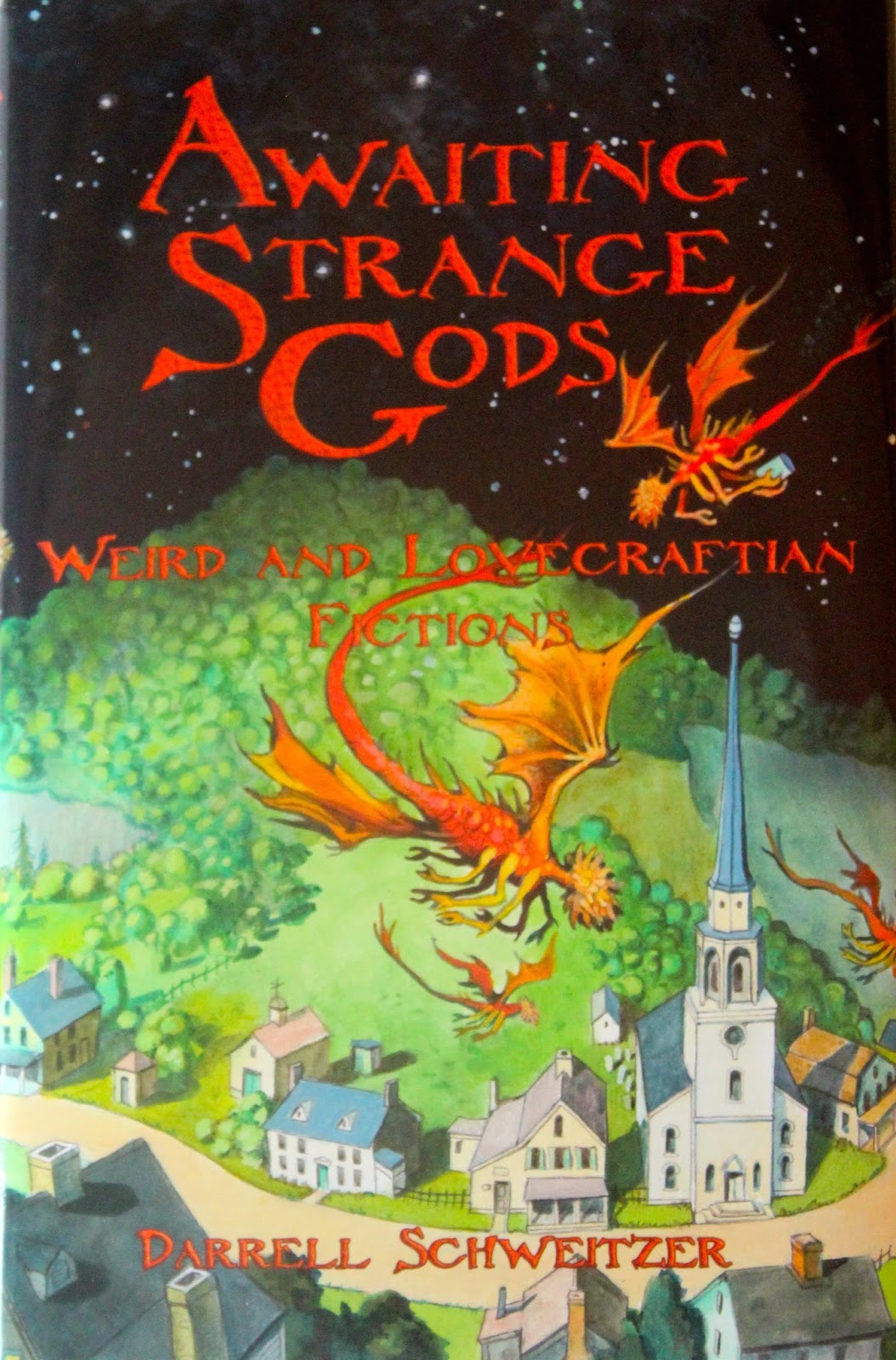


From the wonderful publishing house of Fedogan & Bremer, with a soon to be classic cover, painting by Tim Kirk, cover design Michael Waltz, we have a collection from one of my favourite Lovecraftians, both as author and editor, Darrell Schweitzer. Yes the editor of the brilliantly bleak, soul-wrenchingly dystopian collection Cthulhu's Reign, hint nothing ends well, is also a great writer. Not all of the works are clearly Lovecraft pastiches but those that aren't are still cosmic in scale and some of the best stories in the collection. Just to mention two, the very powerful Howling in the Dark and The Clockwork King, the Queen of Glass, and the Man with a Hundred Knives. It was the latter tale that really cemented Schweitzer's stature in my mind. When I read this tale of a man "trapped?" between our reality and the kingdom of the Clockwork King and the Queen of Glass I was blown away. When I read this story I thought not of HPL but of Jonathan's Carroll's The Land of Laughs and the tantalizing fragments of the children's books, The Land of Laughs, The Pool of Stars, Peach Shadows, and The Green Dog's Sorrow that he attributes to the mysterious author Marshall France. And while I like HPL if you have not read Carroll's The Land of Laughs, A Child Across the Sky, Bones of the Moon, Outside the Dog Museum give Howard a rest and find one or more of these titles.

TOC
Introduction" S.T. Joshi
Envy, the Gardens of Ynath, and the Sin of Cain
Hanged Man and Ghost
Stragglers from Carrhae
The Eater of Hours
The Runners Beyond the Wall
On the Eastbound Train
Howling in the Dark
Sometimes You Have to Shout about It
The Head Shop in Arkham"
Innsmouth Idyll
Class Reunion
Why We Do It
The Warm
Spiderwebs in the Dark
The Corpse Detective
Jimmy Bunny
The Last of the Black Wind
In Old Commoriom
The Clockwork King, the Queen of Glass, and the Man with a Hundred Knives
The Scroll of the Worm with Jason Van Hollander
Those of the Air  with Jason Van Hollander
Ghost Dancing

Monday, March 7, 2016

The Real Shadow Over Innsmouth


The Real Shadow Over Innsmouth

The odd, possibly, in light of the current controversy, prophetic cover for this 1944 edition of Lovecraft's stories


As I have already noted in my introduction, HPL was a racist. It is clear to me that his strong aversion to the other, extended not only to non-Aryan groups but it also to people he considered lower class, the country folk of The Dunwich Horror, the squatters of The Lurking Fear, the poor " the two-year-old child of a clod-like laundry worker named Anastasia Wolejko had completely vanished from sight" in his story Dreams in a Witch-House. If he had used local instead of clod-like it would perhaps, have shown a degree of empathy that HPL apparently lacked when considering the death of a child. That he lived in racist times there is no doubt, we obviously still do, but so were the times that gave us the British Slavery Abolition Act of 1833, and the Emancipation Proclamation of 1863, HPL sank rather than rose to the occasion. HPL's letters do not help his case because they demonstrate that he brought a vile and sadistic imagination to bear when he discussed encounters with non-Aryan peoples, that I suspect was extreme even in his own time. The reason that I am discussing this now, is that I intend to use this blog to highlight web resources that I think would be of interest to any reader of HPL's work. I recently read an excellent discussion of this topic, The "N' Word Through the Ages: The Madness of H.P. Lovecraft by Phenderson Djeli Clark, at Racialicious which provided excellent quotes from his letters.

http://www.racialicious.com/2014/05/28/the-n-word-through-the-ages-the-madness-of-hp-lovecraft/

I was directed to this post by the Salon article, Its Ok to admit that H.P. Lovecraft was racist, which I also recommend.

http://www.salon.com/2014/09/11/its_ok_to_admit_that_h_p_lovecraft_was_racist/

Will I close this blog down and sell off my books, not at present. I have been reading HPL's stories and letters for years as well as those of his contemporaries and I was aware of this unfortunate trend. While HPL was more extreme and/or possibly more vocal, racism and misogyny are common in both the early pulp fiction genre and the science fiction works that grew out of it. Often these ideas so dominate the works that the story or novel suffers when compared to the author's less polemic works. For that reason I suggest you skip the very badly written The Horror at Red Hook and read instead The Colour Out of Space, The Outsider, or one of my favourites for HPL at his world building best The Shadow out of Time


Tuesday, February 2, 2016

New Eldritch Tomes

My library of Lovecraftian tomes has expanded over the last month. One of the most eagerly awaited was a preorder from Subterranean Press Beneath an Oil-Dark Sea The Best of Caitlin R. Kieran Vol. 2. How could I resist adding a book with such a stunning dust jacket by such a talented author to my library. I first learned of Kiernan while watching the documentary Lovecraft: Fear of the Unknown on YouTube. I felt her comments were particularly relevant and I soon looked up her work. As someone who has worked in archaeology and has also had a life long interest in vertebrate palaeontology, I was particularly interested to learn that she had published in the Journal of Vertebrate Paleontology. I have read and enjoyed a number of her mythos tales, especially the whimsical and "romantic" “Love Is Forbidden, We Croak and Howl” in Lovecraft's Monsters edited by Ellen Datlow. I was really impressed by another Subterranean Press offering, her novella entitled The Dry Salvages. A SF work rather than a typical mythos tale it combines her love of palaeontology with the rather enigmatic tale of a doomed expedition investigating the remains of an extraterrestrial mining colony on the moon of the gas giant Cecrops. It has a subtle, haunting flavour I often associate with European SF and I recommend it. 


Thursday, December 24, 2015


“Happy Christmas to all, and to all a good night!”

                        From A Visit from St. Nicholas
                        by  Clement Clarke Moore

Saturday, December 5, 2015

New Eldritch Tomes

Another new addition for this week, from 
Innsmouth Free Press, and another lovely cover.

"They say she has always been there, as old as the station's rust..,"

from Provenance
by Benjanun Sriduangkaew


Cover Art Sarah K. Diesel

Thursday, December 3, 2015

New Eldritch Tomes


Cover Art by Jason Van Hollander
Cover Design by Michael Smith

A couple of new tomes arrived from PS Publishing, and they look wonderful. I really enjoyed Schweitzer anthology Cthulhu's Reign, so I am looking forward to this one. And who could pass on a trip to the Lovecraft Museum?


Jacket Art by Jason Van Hollander
Jacket Design Alligator Three Graphics


Wednesday, November 18, 2015

Discovery of the Ghooric Zone, Richard A. Lupoff

I had intended to write my first post about Charles Stross’s "Colder War", but I am still working on it. So instead I have chosen Richard A. Lupoff’s "Discovery of the Ghooric Zone - March 15, 2337", from Tales of the Cthulhu Mythos, by H.P. Lovecraft & Divers Hands, published by Arkham House, 1990. First a bit of my history with this title. When I decided to collect Lovecraft I began by purchasing the  collections, Dagon, The Dunwich Horror, and At the the Mountains of Madness, which had been revised in the mid 1980’s by S.T. Joshi for Arkham House, I believe I ordered this book at the same time. A further aside, this was when purchasing books required actual correspondence with paper and stamps, and I want to say I found April Derleth very helpful and a real pleasure to deal with, and the Arkham House staff still are. 

I do remember that when I first read this collection I really disliked the Lupoff story and did not finish it. At the time my mental image of a Lovecraft story involved a somewhat naive narrator who inherits or otherwise encounters a forbidden tome (there are so many, with such large print runs), has somewhat bizarre dreams, and finds a family tree with some interesting side shoots. So the stories by Derleth, Long, Block, Kutter etc. were more to my taste. However, my vision of what constitutes a good “Lovecraft” story has expanded over the years, thanks to some really inventive authors.

Re-reading the Lupoff story recently, I was really impressed by his ability to weave Lovecraftian elements into such a modern feeling SF story. Even though it was initially published in the anthology Chrysalis 1, edited by Roy Torgeson, in 1977, the SF elements still felt fairly modern to me. However I still dislike the Jeffrey K. Potter illustrations and cringe every time I see his work on yet another release by one of my favourite writers, James Blaylock. 

Lupoff's work has been described as recursive and relying heavily on pastiche. His novel Lovecraft’s Book, also published by Arkham House is a historical novel involving Lovecraft and fascists, and he has written a novel Circumpolar based on the idea of a hollow earth. Another Countersolar is considered an early example of steampunk.


James Turner the editor of the anthology offered the following assessment of "Discovery of the Ghooric Zone" in his introduction."In this brilliant narrative Lupoff managed to include not only the requisite Mythos terminology but also the essential ambience of cosmic wonder and then additionally has re-created some of the mind-blasting excitement of the original Mythos Stories."


But on to our story, the year is 2337 and the spaceship Khons is travelling from Pluto to a Planet X located at the edge of the solar system. Aboard are three human cyborgs, Gomati of Khmeric Gondwanaland, Njord Freyr of the Laddino Imperium, and the commander Shoten Binayakya whose place of origin is unknown. Planet X, or Yuggoth as Gomati names it, is a large red gas giant with numerous moons including the twin moons Thog and Thok. The decision is made to land on Thog as there are obvious ruins from a past civilization. The story of the trip is interspersed with accounts of the rise of the Laddino Imperium and Khmeric Gondwanalan. Despite the unusual setting and characters, Lupoff has captured the cosmic span of some of Lovecraft’s best passages from stories like "At the Mountains of Madness", "The Shadow out of Time", and the "Whisperer in Darkness" from which we get the original description of Yuggoth. For in the "Whisperer in DarknessYuggoth will be the first destination for the Mi-Go carrying the character Akeley’s disembodied brain housed within a metal cylinder, 

  “ It is a strange dark orb at the very rim of our solar system... There are mighty cities on Yuggoth—great tiers of terraced towers built of black stone like the specimen I tried to send you. That came from Yuggoth. The sun shines there no brighter than a star, but the beings need no light. They have other subtler senses, and put no windows in their great houses and temples. Light even hurts and hampers and confuses them for it does not exist at all in the black cosmos outside time and space where they came from originally. To visit Yuggoth would drive any weak man mad—yet I am going there. The black rivers of pitch that flow under those mysterious cyclopean bridges—things built by some elder race extinct and forgotten before the beings came to Yuggoth from the ultimate voids—ought to be enough to make any man a Dante or Poe if he can keep sane long enough to tell what he has seen.”

from “The Whisperer in Darkness", H.P. Lovecraft p.259

And Lupoff has all the elements, strangely lit cyclopean ruins, the rise and fall of empires, a vast cosmic scale, and enough other references to the mythos to keep any Lovecraft fan happy.

 “Yuggoth itself hung directly overhead, obscenely bloated and oblate, its surface filling the heavens, looking as if it were about to crash shockingly upon Khons and the three explorers,  and all the time pulsing, pulsing, pulsing like an atrocious heart, throbbing, throbbing."
p.523

As I mentioned above one of the things I love most about Lovecraft is the great empire building passages in the stories from his later years like "At the Mountains of Madness", "The Shadow out of Time", and "The Whisperer in Darkness" and his attempt to depict fantastic dreamlike alien landscapes. I have always felt that it was unfortunate that Lovecraft had become so discouraged with his lack of success just when he had found his own voice free of the influence of Poe, Dunsany and others, and that he seems to have written little fiction in his last few years.

Lupoff has not only an extensive knowledge of the mythos but also the imagination and ability necessary to weave it into a story that is very much his own. For many years my favourite non-HPL Yuggoth story was "The Mine on Yuggoth" from Ramsey Campbell’s Inhabitants of the Lake, but I think it has been usurped. I do still like the Campbell story and hope to have several posts on his work in the future.