Sunday, April 26, 2020


Sunday, March 29, 2020
Fritz Leiber Witchcraft and Whatnot

I had not intended to post on works that might be seen to address aspects of the situation we currently find ourselves in with the coronavirus. But anyone who has followed my blogs would know that the process I follow when choosing works to discuss, despite my best efforts, is unpredictable. So I often find myself in unexpected territory. Like here. Last night I was reading a post on the unsubscribed blog on the Bruce Pennington covers for the work of Clark Ashton Smith.
This led me to, in a process too long to describe, to Lankhmar The Fritz Leiber Home Page.
There I found a reference to a Fritz Leiber story "Hatchery of Dreams" I recognized the story immediately upon seeing the cover of its original appearance in Fantastic Stories of the Imagination.
I still had not decided to do a post on Fritz Leiber, but while digging out my Clark Ashton Smith books (remember Alice), I found my copy of The Witchcraft Reader, which contains "The Warlock" by Fritz Leiber.
"The Warlock" begins with the confession by the narrator that he has caused his "friend" Jamie Bingham Walsh's death by forcing him off a cliff. He also makes his reasons clear right away. Jamie is a witch or warlock.
"to me a witch _ a modern witch, a real witch - is a person who is a carrier of insanity, one who infects others with this or that deadly psychosis without showing any of the symptoms himself, one who may be brilliantly sane by all psychiatric tests but who nevertheless carries in his mind-stream the germs of madness."
"By the same reasoning, Jamie Bingham Walsh should have been known as Schizo Jamie. People with whom he came in really close contact had their minds split and started to live in dream worlds."
and
" Most of us are willing to recognize the carrier of insanity when he operates at the national or international level. No one would deny that Hitler was such a carrier, spreading madness among his followers until he grew so powerful that there was no asylum strong enough to hold him." (60)
We have heard this confession, the killing of a friend for whatever reason, possession in the case of the narrator of Lovecraft's "The Thing on the Doorstep" or, in this case, the narrator holds James responsible for his sister's madness. This is a hackneyed trope across both mythos fiction and the horror tale in general. But here, Leiber provides a depth of plot and description to create a very readable psychological study. That some aspects of the story (quoted in part above) seem a bit prescient today is probably my imagination.
The second story "Hatchery of Dreams" is one I originally read years ago, in Rod Serling's Triple W: Witches, Warlocks and Werewolves. I have owned this anthology since I was a teenager. It is probably one of the of the paperbacks I have owed the longest with all the culls and moves my collection has undergone. I have no idea where it came from it was probably a gift. I suspect I will pull more stories from it to discuss in the future.

"Hatchery of Dreams" is the story of Giles Wardwell, a rather proper Bostonian who works for the CAMZ, a cold war-style organization tasked with rooting out communists. Or so, Giles thinks. The story opens when Giles wakes up and finds his much younger wife Joan missing. A note indicates she is taking a break possibly permanent from their marriage. Giles is unconvinced. First, he explores the home laboratory where Joan makes cosmetics. Here, Giles discovers a head-sized white egg that looks like it is about to hatch. Next, he visits the three young women that are Joan's bridge partners. Each is ill, the last Mary Nurse, cuddling a giant spider stuffy, tells Giles to return home for the eggs hatching if he loves his wife. "The Hatchery of Dreams" is an enjoyable story. It would probably be considered somewhat sexist today, but it is a fast paced adventure.
I would say it is not quite as interesting or well written as "The Warlock
but more fun. Leiber pulls together a lot of connections in terms of names and incidents from New England's history with witchcraft. Leiber then merges this history with McCarthyism and cold war paranoia quite effortlessly.
I would say it is not quite as interesting or well written as "The Warlock
but more fun. Leiber pulls together a lot of connections in terms of names and incidents from New England's history with witchcraft. Leiber then merges this history with McCarthyism and cold war paranoia quite effortlessly.

Witchcraft sees to be a theme that interested Leiber. We see it again in his novel Conjure Wife, and the Wikipedia article on Leiber's novel Our Lady of Darkness mentions Bruce Byfield's Witches of the Mind: A Critical Study of Fritz Leiber. This use of witches as characters and the broader references to witchcraft in the history of New England is something Leiber shares with Lovecraft. This shared interest, may in part, explain the connection between these two writers.
Covers:
The Witchcraft Reader cover by Josh Kirby
Rod Serling's Triple W: Witches, Warlocks and Werewolves This unforgivable atrocity of a cover is unattributed. I am surprised the publisher did not recall all the copies and burn them. But it was used for at least two editions, so maybe it is just me. What do you think?
Conjure Wife cover by Robert Maguire
Covers:
The Witchcraft Reader cover by Josh Kirby
Rod Serling's Triple W: Witches, Warlocks and Werewolves This unforgivable atrocity of a cover is unattributed. I am surprised the publisher did not recall all the copies and burn them. But it was used for at least two editions, so maybe it is just me. What do you think?
Conjure Wife cover by Robert Maguire
Tuesday, March 24, 2020
Hugh B. Cave "The isle of Dark Magic" and "The Death Watch"

I have not read a great deal of Cave's work, but a few years ago, I was lucky enough to get a copy of of the Carcosa edition of Murgunstrumm and Others, and as a small press collector I snapped it up. I did read a few of the stories, but they did not seize my imagination. Recently, however, I learned that Cave had penned a couple of mythos tales, "The Death Watch" and "The Isle of Dark Magic," and I read both. I will be including some spoilers when discussing the general themes of the stories.
At the beginning of "The Isle of Dark Magic," we are told that Captain Bruk was on the beach when he accepted the command of the Bella Gale, a schooner-rigged tramp picking up cargo in the south seas. One of his first duties is transporting Peter Mace and his very large trunk to the island of Faikana. Faikana is not the island negotiated between Mace and the company, but once he is on board, Mace bribes Bruk to take him to one of the most sparsely occupied islands available. Indeed Faiikana's only inhabitants are a small native village and a rather nosey missionary. Mace has the villagers build him an isolated cabin with a small second-story room only he is allowed to enter. But eventually, we learn that the first floor contains a number of forbidden books (do we really need a list), and that the second floor contains a sculpture of Mace's dead lover, Maureen Kennedy. Maureen died of natural causes, but before burying her in an unmarked grave, Mace has had the statue constructed by an artist friend. Eventually, Mace's obsession with the statue and his various books of forbidden lore prove to be too much even for his friend, and he has come to Faikana to continue his work. He is all too successful, and Bruk returns to the island with a second passenger.

"The Death Watch" is related by Harry, who works nights at a radio station in rural Florida. He is friends with Elaine and Peter Ingram, who rent a large rundown manor house at the edge of a swamp. At one point, Elaine lived there with her mother and brother Mark. Eventually, she left to marry
Peter. Mark remained alone in the house until he died sometime later. Harry was one of only two people present when Mark died. Elaine has become obsessed with Mar's death and quizzes Harry about Mark's last words. Harry admits that yes, Mark said how much he loved her, and when pressed, he admits not entirely truthfully that Mark promised to return. This promise and a collection of old occult books consume her time to the extent that Peter is quite worried about her mental state.
Elaine has also invited old Yago a Seminole shaman, to share the house with Peter and her. At a loss at how to proceed, Peter, having learned a lot about radio equipment on visits to the station where Harry works, begins to build his own set. As Peter begins to look ill and drained by his efforts, Harry investigates only to find that Peter is not only using quite advanced radio manuals but also Eliane's strange old books. One night Harry is at the station subbing for a sick friend when he hears Pater's first broadcast and heads for the house. But of course, he is too late.

Overall I thought Cave's stories were okay. The mythos elements, however, consisted of a list of books and a few chanted names used in rituals to raise the dead. When I was in grade eight, a friend introduced me to Jack London's South Sea Tales and the adventures of Captain David Grief. I loved these books and still have copies. When I read the beginning of "The Isle of Dark Magic," and was told that Captain Bruk was on the beach when he accepted the command of the Bella Gale, a schooner-rigged tramp picking up cargo in the south seas, I hoped the story might have some of that flavour. Instead, Bruk is a nautical UPS courier delivering the characters to their doom. Cave toured that Pacific as a reporter in WWII and ran a coffee plantation in Hati for five years. He also wrote a critically acclaimed non-fiction book on voodoo based on his years in Hati. I enjoy Henry S. Whitehead's voodoo tales and might have hoped for something similar. Instead, we get Pygmalion mixed with any number of stories of dead lovers, family members, murder victims etc. bent on vengeance. As one might expect from a story entitled "The Death Watch' the theme here is pretty much the same without the statue. In both stories, Cave did inject some interesting elements in "The Isle of Dark Magic" the statue acts, it seems out of jealousy rather than vengeance. In "The Death Watch" the use of radio could have made for an interesting element in the story. But I think Cave largely wasted it, choosing instead to rely on the overused pulp trope of the startling revelation in the last couple of lines to tie the story together.
I would try Cave again, although not right way. I would be interested to see how he is when he is being Hugh B. Cave and not HPL.
Sunday, March 22, 2020
New Eldritch Tomes and Vintage Horror Paperbacks (The Pan Book of Horror Stories Series)
I have wanted to add some copies of The Pan Book of Horror Stories series to my library for some time. Recently I received volumes 1-3, 7 from a UK bookseller and I was delighted with the wonderfully atmospheric covers.


But I did not want to do a simple show and tell post. With everything that is going on I have not put together a more in-depth post for some time. However I did want to discuss at least one story from vol 1. "W.S." by L.P.Hartley. Hartley is possibly best remembered today for the quote, “The past is a foreign country; they do things differently there.” from his novel The Go-Between. However he wrote a number of stories of interest to weird fiction fans. Many were collected in the Arkham House collection, The Travelling Grave and Other Stories. "W.S." does not appear in this collection. But it has been reprinted a number of times including an appearance in The Magazine of Fantasy and Science Fiction, August 1952, which can be located at The Luminist Periodical Archives, Science Fiction, Fantasy and Weird Fiction (link below). "W.S" is the story of the novelist Walter Streeter who begins to receive a series of rather cryptic postcards signed only W.S.. While they seem somewhat enigmatic, they do include rather pointed questions about his work and how it can be seen as a reflection on his personality. The horror here is not overt but rather understated, possibly more modern than much of the pulp style fiction of the era including other work by Hartley that I have read. If I could make a comparison I would suggest some glancing similarities to the work of the brilliant writer Jonathan Carroll who I heartily recommend.
http://www.luminist.org/archives/SF/
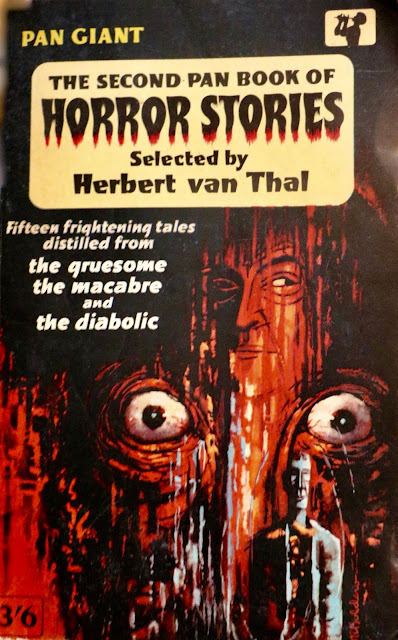


I have also been reading the posts and ogling the covers on Uncle Doug's Bunker of Vintage Horror Paperbacks. The site does not appear to have been updated since 2015 but since nothing on it is remotely time sensitive it is still fun viewing for fans of the the paperbacks of this era.
"Hi! This is my attempt at starting a small blog about, what is in my eyes, the golden age of Horror Anthology Paperbacks and a huge passion of mine. Update: I've realized that what is even more important is the people have to be made aware of these wonderful stories before they disappear forever. Most the the stories I mention here haven't been reprinted in over 40 years and most likely will never been seen again. They will be lost to us once these books are gone and forgotten. How sad."
http://uncledougsbunkerofhorror.blogspot.com/
I do think the sheer number of books pictured on this blog, and the fact that my room and display space is filling up means that my collecting as such will slow down.
Cover credits
Pan Book of Horror Stories, cover unattributed
Second, S. R. Boldero
Third, W. F. Phillipps
Seventh, cover unattributed
Eighth, cover unattributed
Twelfth, cover unattributed


But I did not want to do a simple show and tell post. With everything that is going on I have not put together a more in-depth post for some time. However I did want to discuss at least one story from vol 1. "W.S." by L.P.Hartley. Hartley is possibly best remembered today for the quote, “The past is a foreign country; they do things differently there.” from his novel The Go-Between. However he wrote a number of stories of interest to weird fiction fans. Many were collected in the Arkham House collection, The Travelling Grave and Other Stories. "W.S." does not appear in this collection. But it has been reprinted a number of times including an appearance in The Magazine of Fantasy and Science Fiction, August 1952, which can be located at The Luminist Periodical Archives, Science Fiction, Fantasy and Weird Fiction (link below). "W.S" is the story of the novelist Walter Streeter who begins to receive a series of rather cryptic postcards signed only W.S.. While they seem somewhat enigmatic, they do include rather pointed questions about his work and how it can be seen as a reflection on his personality. The horror here is not overt but rather understated, possibly more modern than much of the pulp style fiction of the era including other work by Hartley that I have read. If I could make a comparison I would suggest some glancing similarities to the work of the brilliant writer Jonathan Carroll who I heartily recommend.
http://www.luminist.org/archives/SF/
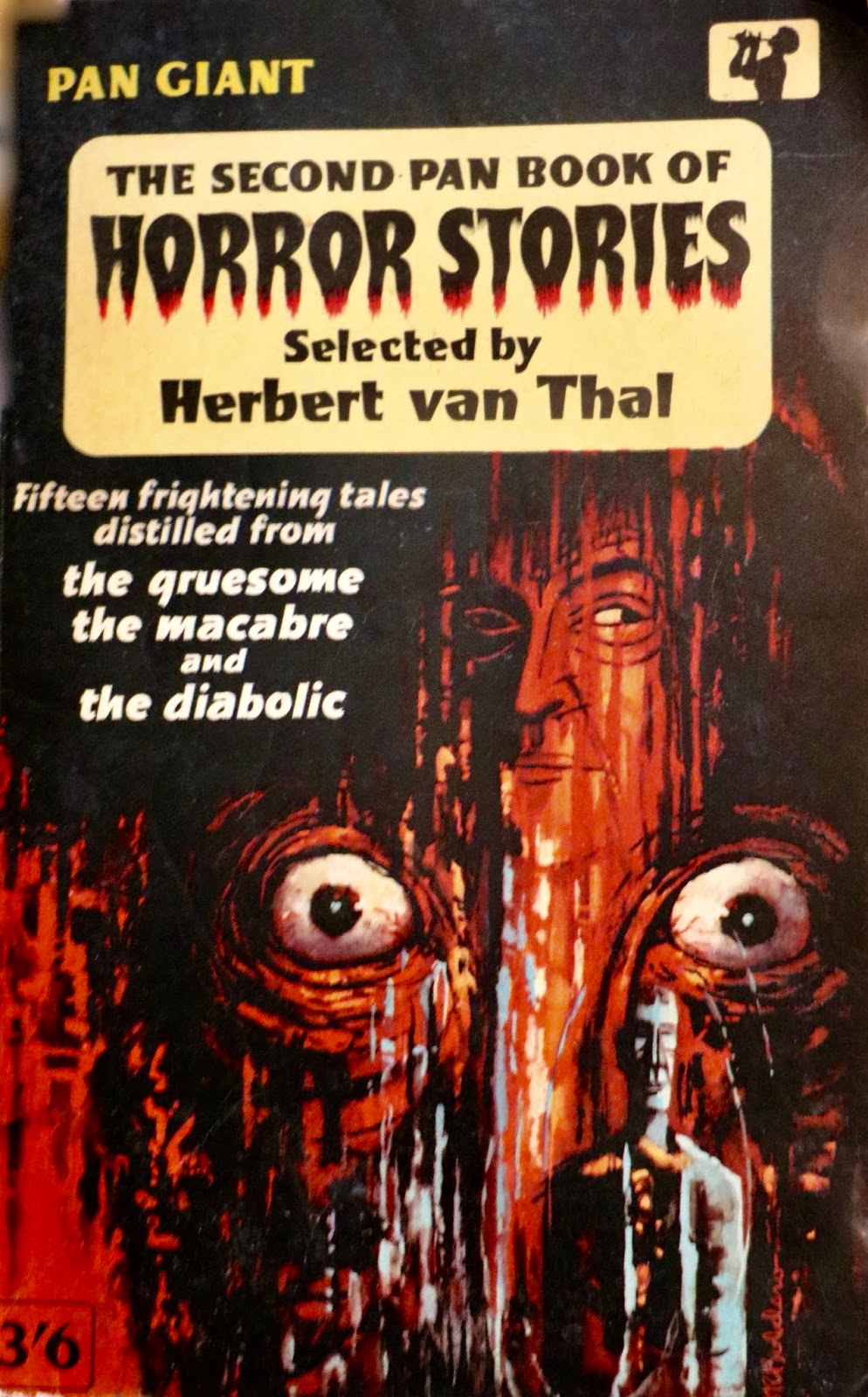


I procured vols. 8 and 12 in Calgary, some time ago, from the now sadly defunct Cabin Fever Books but the covers just do not have the same cache for me. One problem is I just do not like covers utilizing photographs as much.


"Hi! This is my attempt at starting a small blog about, what is in my eyes, the golden age of Horror Anthology Paperbacks and a huge passion of mine. Update: I've realized that what is even more important is the people have to be made aware of these wonderful stories before they disappear forever. Most the the stories I mention here haven't been reprinted in over 40 years and most likely will never been seen again. They will be lost to us once these books are gone and forgotten. How sad."
http://uncledougsbunkerofhorror.blogspot.com/
I do think the sheer number of books pictured on this blog, and the fact that my room and display space is filling up means that my collecting as such will slow down.
Cover credits
Pan Book of Horror Stories, cover unattributed
Second, S. R. Boldero
Third, W. F. Phillipps
Seventh, cover unattributed
Eighth, cover unattributed
Twelfth, cover unattributed
Thursday, February 20, 2020
NewNew Eldritch Tomes, Richard Powers, Robert Bloch, Fritz Leiber
Anyone who has followed my blogs will know that science fiction and weird tale/horror illustration is an area of real interest to me. I also love the slim horror anthologies and collections that appeared in the 1950's/1960's/1970's. So I could not resist these especially as Bloch and Leiber were part of Lovecraft's circle and fine writers in their own right. I have not been able to identify the cover artist of The Living Demons, isn't it lovely. But the rest are by Richard Powers, in a class by himself yet again. I have provided links below to other posts featuring Powers covers. I also enjoy seeing the advertisements on the back with other titles I might look for. I would love to know which is your favourite cover. Please enjoy.


Not a new arrival but when I saw Invisible Men included both Basil Davenport as editor and Richard Powers as cover artists I had to include it.
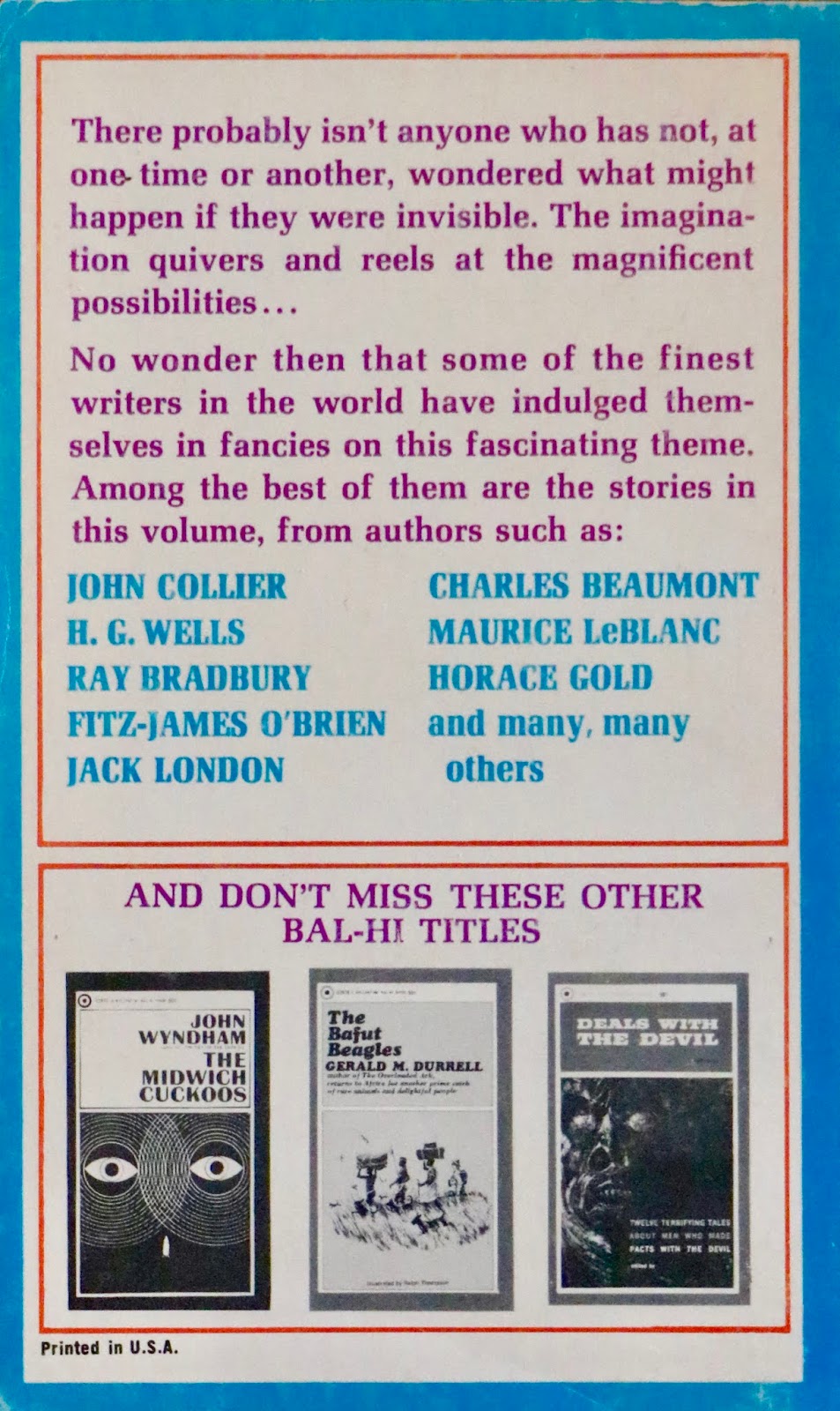

Pervious links to Powers Covers.
https://dunwichhorrors.blogspot.com/2016/04/horror-anthologies-and-art-of-richard.html
https://dunwichhorrors.blogspot.com/2016/05/horror-anthologies-art-of-richard.html
https://dunwichhorrors.blogspot.com/2016/05/horror-anthologies-art-of-richard.html
Friday, February 14, 2020
"So Runs the World Away" by Caitlin R. Kiernan

An aspect of his writing that gets less attention is his tales of a very puritanical witch-haunted New England. The doomed protagonists of his tales often find Margaret Murray'sThe Witch-Cult in Western Europe among the more eldritch tomes on the bookshelves they consult. Lovecraft himself offers us the witch Keziah Mason and her familiar Brown Jenkin in "The Dreams in the Witch House".
"He was in the changeless, legend-haunted city of Arkham, with its clustering gambrel roofs that sway and sag over attics where witches hid from the King’s men in the dark, olden days of the Province." 1
The oft scorned figure of Cotton Mather stalks by the gallows hill and the graveyards holding the ancestors of still more doomed narrators.
"Beside the road at its crest a still higher summit rose, bleak and windswept, and I saw that it was a burying-ground where black gravestones stuck ghoulishly through the snow like the decayed fingernails of a gigantic corpse. The printless road was very lonely, and sometimes I thought I heard a distant horrible creaking as of a gibbet in the wind. They had hanged four kinsmen of mine for witchcraft in 1692, but I did not know just where." 2
"You call the Salem witchcraft a delusion, but I’ll wage my four-times-great-grandmother could have told you things. They hanged her on Gallows Hill, with Cotton Mather looking sanctimoniously on. Mather, damn him, was afraid somebody might succeed in kicking free of this accursed cage of monotony—I wish someone had laid a spell on him or sucked his blood in the night!
“I can shew you a house he lived in, and I can shew you another one he was afraid to enter in spite of all his fine bold talk. He knew things he didn’t dare put into that stupid Magnalia or that puerile Wonders of the Invisible World." 3
It is the modern version of this haunted New England that Caitlin R. Kiernan offers us in "So Runs the World Away" It is the story of the Dead Girl, her rival Gable, the boy Bobby, all of whom who live along the bank and in the waters of the Seekonk River. It is also the story of the strange house on Benefit Street, where the abnormally long-lived Miss Josephine holds forth on great disasters she has seen to her friends. A "rough circle of men and women that always makes the Dead Girl think of ravens gathered around carrion, blackbirds about a raccoon's corpse, jostling each other for the best bits" 4 It is also in the basement of the house on Benefit street that Madam Terpsichore instructs the younger ghouls in the correct away to dismember a corpse.
The Dead Girl and her companions move between both groups tolerated if not welcome. It is in the basement that the Dead Girl always seeking details of her past, quizzes the ghoul Barney about a strange vision of death she has had.
'I think I eat them," Dead Girl says. "But there are blackbirds then, a whole flock of blackbirds, and all I can hear are their wings. Their wings bruise the sky.' 5
But Barney refuses to tell her for fear of the reaction of the Baliff, a menacing figure who seems to exert a great deal of control over the group surrounding the Dead Girl. Later the Dead Girl takes a friend on a pilgrimage to Lovecraft's grave; a trip Kiernan must herself have made a number of times when she lived in Providence, Rhode Island.
To avoid spoilers, I will end my description of the story here.
Having followed Kiernan's blog for years, I know she brings what seems like an encyclopedic knowledge of among other topics, Lovecraft's work, deep time, folklore, science, science fiction and horror to her tales. This knowledge includes film and music, as well as the written word. Like Lovecraft, she seems to visit a number of the sites she writes about as part of her research. And like Lovecraft, she often positions the fantastic elements of her stories within a network of real locations and events, quotations, newspapers clipping, and scientific facts.
She also writes beautifully and evocatively.
"People have carved things," she says and strikes the lighter again, holds the flickering blueorange flame so that Adrian can see all the pocket-knife graffiti worked into the smooth, pale bark of the tree. The unpronounceable names of dark, fictitious gods and entire passages from Lovecraft, razor steel for ink to tattoo these occult wounds and lonely messages to a dead man, and she runs an index finger across a scar in the shape of a tentacle-headed fish." 6
I enjoyed the story; some may find ending is a bit ambiguous. I follow Kiernan's blog, and I seem to remember her mentioning that an editor of an anthology she was participating in complained that the conclusion of a story was ambiguous and rather than clarify it, she withdrew the story. I love that. I hate weird tales that offer too much explanation or even worse a prosaic explanation. I am mad for example, or in the case of William Hope Hodgson's worst Carnacki stories, criminals staged the entire haunting.
In their introduction to The Weird: A Compendium of Strange and Dark Stories, Ann and Jeff Vandermeer quote Lovecraft on the weird tale.
"Instead, it represents the pursuit of some indefinable and perhaps maddeningly unreachable understanding of the world beyond the mundane – a ‘certain atmosphere of breathless and unexplainable dread’ or ‘malign and particular suspension or defeat of … fixed laws of Nature’ – through fiction that comes from the more unsettling, shadowy side of the fantastical tradition."
The Vandeermer's also state
"Because The Weird is as much a sensation as it is a mode of writing, the most keenly attuned amongst us will say ‘I know it when I see it,’ by which they mean ‘I know it when I feel""
They go on to say
"In either instance, subtle or bold, The Weird acknowledges that our search for understanding about worlds beyond our own cannot always be found in science or religion and thus becomes an alternative path for exploration of the numinous."
For me, this is similar (not in content but impact) to the sense of wonder in science fiction. It is a point in which some aspect of the story transports my reading self out of the narrative into the realm of sensation or imaginative experience. And it is very much a matter of knowing it when I see it or rather experience it. The events within a weird tale are things of mood and atmosphere rather than something that can be categorized. They are very much experiences of the what (real or not). What happened, what did I feel, what did I see, rather than how or why did something happened.
I read this in the PS Publishing collection of Kiernan's stories To Charles Fort
With Love. It was followed by a discussion of the inspiration for the story and it's place within her body of work. I typed it while listening to the album Broadcast and The Focus Group Investigates Witch Cults Of The Radio Age, because I could.
Caitlin R. Kiernan's Online Journal is here,
Footnotes
1 HPL, "The Dreams in the Witch House. "
2 HPL, "The Festival"
3 HPL, "Pickman's Model"
4-6 Kiernan, "So Runs the World Away"
Subscribe to:
Comments (Atom)