" It is new, indeed for I made it last night in a dream of strange cities: and dreams are older than brooding Tyre, or the
contemplative Sphinx, or garden-girdled Babylon" The Call of Cthulhu

Saturday, May 23, 2020


  I have mentioned several times how much I enjoy the Ballantine horror anthologies with the Richard Powers covers. Today I want to look at one story from this anthology, "The Graveyard Reader" by Theodore Sturgeon.

In his introduction, Conklin states, " I have always loved graveyards: country ones, in particular, but even city ones, too, if they are old and, to all intents and purposes, finished. These are the historic graveyards of the seventeenth and eighteen centuries, with their small green demesnes full of weathered and crumbling tombstones, city oases set in the midst of deserts of paved streets and of stone and glass anthills full of too many people. Of country graveyards, only this need be said: that in them is written the history that shall never be fully read: the history of simple people. And of all the graveyards this can always be said: that though they may be sad places, they are also peaceful."(7)

As a teenager in Windsor, Ontario a friend and I would occasionally end our nightly perambulations on a bench in the graveyard attached to a huge brick Anglican church. The area was old enough for sections of the original cobstone streets to be seen in spots where the asphalt had worn away. It was an extremely atmospheric spot; I should mention that it was this friend who introduced me to the works of H.P. Lovecraft. 

Conklin goes on to thank Sturgeon "immeasurable thanks to Theodore Sturgeon, for being inspired by the title of this book to turn out an unforgettable original tale under the same name for me."(8) Fittingly enough, the story begins with a man visiting the grave of his newly deceased wife. The stone was included in the plot's price, and he is trying to decide what it should say. It is at this point that he backs up, inadvertently stepping on the foot of a man who has come up behind him. They stand side by side for a time, and then the man asks, "Mind if I read it?"(144) Since the stone does not yet have an inscription, the husband is angered, and the stranger agrees not to read it. He mentions however, that eventually, someone else will. The husband then asks what he is talking about, and the stranger replies, "I don't think you quite understand me. I didn't say I read gravestones. I said I read graves."(145) While the offer to read the grave seems like a good reason for the husband to dismiss the stranger, he is more alarmed by the thought that someone else could come to understand his wife when he was unable too. We learn that she had left home after an argument and that she died in a car accident while riding with a man he did not know three days later. Her death, however, is a symptom of the estrangement that has always haunted their marriage. 

They continue to talk, and eventually, the stranger explains how one can read a grave and come to understand fully, what the occupant did, said or thought. When asked what he reads, he says, " A lot of things, The curve of the mound, the encroachment of growth on it-grass, weeds, mosses. The kind of vegetation that grows there, and the shape of each stem and leaf, even the veining in them, The flight of insects over it, the shadows they cast, the contours of rain-rivulets as they form, as they fill, as they dry." (149) "

"The Graveyard Reader" was a beautifully written story. It is the kind of story I would have expected from Jonathan Carroll or Ray Bradbury. Stories of this type seem to exist at the intersection of fantasy, horror and magic realism. Lately, I have come to see these stories as fabulism, which is described as a form of magic realism. Fabulists, however, are described as writers who compose or relate fables, and I am more comfortable with this description. I see these tales as akin to stories like "Bearskin Soldier" or "The Story of a Boy Who Went Forth to Learn Fear" from Grimms' Fairy Tales.

This is not a story where a lot happens. Sturgeon is relying on the setting, description, atmosphere, and narrator's memories and personal journey to structure the story. Fables often end with a moral lesson, here Sturgeon provides closure without excessive explanations or a predictable denouncement. Whether there is a moral lesson, I will leave to you. Conklin, in his introduction to this specific story, says. "This brand-new story is pure and lovely Sturgeon, Sturgeon at his understated best" (142), and I agree.



Sunday, April 26, 2020

Stories of Hope and Wonder: In Support of the UK's Healthcare Workers


A recent newsletter from PS Publishing noted the following new release. 


"We all of us like—even THRIVE on—a little hope and wonder in our daily grind. Heck, it’s the marmalade on our morning slice of toast, the bracing and blustery wind off the North Sea and the sunlight in our most darkened days (and we’ve had some of those these past few weeks) so I want to sign off this week’s Newsletter with a nod of appreciation in the direction of our chum Ian Whates, head honcho of Newcon Press on a remarkable project.

STORIES OF HOPE AND WONDER contains a rich and varied treasury of quality stories, from dark to light, humorous to menacing, clever to exciting. Fifty-three stories in all, more than a quarter-million words of fiction, including several pieces that are original to the book, featuring some of the finest writers of science fiction, literary fiction, fantasy, horror, and more.

All proceeds from the sale of this digital anthology are being donated to support NHS staff and other UK healthcare workers. So come on, folks, buy your copy by going here—do it now."

My wife and I have watched a number of programs on the work of the NHS, a recent favourite is "The Secret Life Of The Hospital Bed, is a unique 15-part series where, across the 45-minute episodes, fixed-rig cameras tell the story of patients who enter four different hospitals across the country." 


The NHS is a great cause, and I was more than happy to purchase this item. I have several anthologies edited by Ian Whates, including 2001: An Odyssey in Words, so I also knew the collection would be a good one. 

Followers of this blog can only imagine my delight when I found the story "Out of the Wood"s by Ramsey Campbell. I don't think I have discussed Campbell much on this blog. This is a glaring omission considering his status not just as one of the most important writers working within the Lovecraft mythos, but also as one of the most significant British horror writers of this generation. Campbell famously started writing Lovecraft pastiches as a teenager. He submitted some of these stories to August Derleth of Arkham House. Derleth published Campbell's first collection, The Inhabitant of the Lake and Less Welcome Tenants, when Campbell was just 18 years old. 

I have been an enormous fan of Arkham House books for close to 40 years, I know that August Derleth ran the business from Sauk City Wisconson, where he lived. I do not know the physical details of the business, are there separate office buildings, warehouse etc. I like to think Campbell was attempting to capture some of the flavour of Arkham House in this story. 

I found this reference after posting my original entry. The entire article is worth reading.

"Arkham House was never truly financially successful, but the publishing house grew in the decades following its founding nonetheless. August Derleth’s son, Walden, says his father’s success stemmed from his incredible work ethic, and helped the company grow far past the confines of his office.

“He stored books all over the house, but mainly the basement and upstairs in a spare room where he packed the books and got them ready to ship,” Walden said. “In 1968, business had grown so much that he built a warehouse on his land to operate out of, but from 1939- 1967, it was all done out of the house.”"

The story opens with Thirsk, the publisher of rather shoddily bound children's books is holding a business meeting with a new potential printer. Thirsk does not typically hold meetings so late, and being alone with this visitor seems to be unsetting him, as demonstrated by the way he is downing Scotch. The visitor "Little of whom was to be seen outside the heavy brown ankle-length overcoat except a wrinkled knotted face and gnarled hands." is not drinking since Thirsk does not have any untreated water. He also does not appear to be much of a salesman, when Thirsk asks why he should do business with him, he replies, "For you to say, Mr. Thirsk." He seems to be more interested in where Thrirsk's current printer gets his paper and how much Thirsk knows about it. The meeting continues to go downhill, and the visitor exits after leaving a sample book as a gift. Soon we learn the Thirsk's business, a combination office, home and warehouse is located in a wooded area on a deserted road into town. Once Thirsk is alone, things begin to happen; the book is not a typical printed book, noises start in the warehouse, etc. but I will leave you there. 

I enjoyed the story; it is not mythos related. I would describe it as a weird tale, atmospheric without a lot of detail. The logic is intrinsic to the needs of the story itself, and the reader must supply their own explanation of the events. I enjoyed the story. Many of the other authors in the collection are well known, especially for their science fiction, and I am looking forward to finding some other gems here. 


I do want to thank Ian and everyone who who contributed to the collection as well as PS Publishing for bringing it to my attention. Most of all I want to thank everyone trying to keep us safe during this rather trying time. 


Sunday, March 29, 2020

Fritz Leiber Witchcraft and Whatnot

  I had not intended to post on works that might be seen to address aspects of the situation we currently find ourselves in with the coronavirus. But anyone who has followed my blogs would know that the process I follow when choosing works to discuss, despite my best efforts, is unpredictable. So I often find myself in unexpected territory. Like here. Last night I was reading a post on the unsubscribed blog on the Bruce Pennington covers for the work of Clark Ashton Smith. 


This led me to, in a process too long to describe, to Lankhmar The Fritz Leiber Home Page.  


There I found a reference to a Fritz Leiber story "Hatchery of Dreams" I recognized the story immediately upon seeing the cover of its original appearance in Fantastic Stories of the Imagination.


I still had not decided to do a post on Fritz Leiber, but while digging out my Clark Ashton Smith books (remember Alice), I found my copy of The Witchcraft Reader, which contains "The Warlock" by Fritz Leiber.

"The Warlock" begins with the confession by the narrator that he has caused his "friend" Jamie Bingham Walsh's death by forcing him off a cliff. He also makes his reasons clear right away. Jamie is a witch or warlock. 

"to me a witch _ a modern witch, a real witch - is a person who is a carrier of insanity, one who infects others with this or that deadly psychosis without showing any of the symptoms himself, one who may be brilliantly sane by all psychiatric tests but who nevertheless carries in his mind-stream the germs of madness." 

"By the same reasoning, Jamie Bingham Walsh should have been known as Schizo Jamie. People with whom he came in really close contact had their minds split and started to live in dream worlds."

and

" Most of us are willing to recognize the carrier of insanity when he operates at the national or international level. No one would deny that Hitler was such a carrier, spreading madness among his followers until he grew so powerful that there was no asylum strong enough to hold him." (60)

We have heard this confession, the killing of a friend for whatever reason, possession in the case of the narrator of Lovecraft's "The Thing on the Doorstep" or, in this case, the narrator holds James responsible for his sister's madness. This is a hackneyed trope across both mythos fiction and the horror tale in general. But here, Leiber provides a depth of plot and description to create a very readable psychological study. That some aspects of the story (quoted in part above) seem a bit prescient today is probably my imagination. 

The second story "Hatchery of Dreams" is one I originally read years ago, in Rod Serling's Triple W: Witches, Warlocks and WerewolvesI have owned this anthology since I was a teenager. It is probably one of the of the paperbacks I have owed the longest with all the culls and moves my collection has undergone. I have no idea where it came from it was probably a gift. I suspect I will pull more stories from it to discuss in the future.


"Hatchery of Dreams" is the story of Giles Wardwell, a rather proper Bostonian who works for the CAMZ, a cold war-style organization tasked with rooting out communists. Or so, Giles thinks. The story opens when Giles wakes up and finds his much younger wife Joan missing. A note indicates she is taking a break possibly permanent from their marriage. Giles is unconvinced. First, he explores the home laboratory where Joan makes cosmetics. Here, Giles discovers a head-sized white egg that looks like it is about to hatch. Next, he visits the three young women that are Joan's bridge partners. Each is ill, the last Mary Nurse, cuddling a giant spider stuffy, tells Giles to return home for the eggs hatching if he loves his wife. "The Hatchery of Dreams" is an enjoyable story. It would probably be considered somewhat sexist today, but it is a fast paced adventure. 

I would say it is not quite as interesting or well written as "The Warlock
but more fun. Leiber pulls together a lot of connections in terms of names and incidents from New England's history with witchcraft. Leiber then merges this history with McCarthyism and cold war paranoia quite effortlessly. 


Witchcraft sees to be a theme that interested Leiber. We see it again in his novel Conjure Wife, and the Wikipedia article on Leiber's novel Our Lady of Darkness mentions Bruce Byfield's Witches of the Mind: A Critical Study of Fritz Leiber. This use of witches as characters and the broader references to witchcraft in the history of New England is something Leiber shares with Lovecraft. This shared interest, may in part, explain the connection between these two writers. 

Covers:

 The Witchcraft Reader cover by Josh Kirby

Rod Serling's Triple W: Witches, Warlocks and Werewolves This unforgivable atrocity of a cover is unattributed. I am surprised the publisher did not recall all the copies and burn them. But it was used for at least two editions, so maybe it is just me. What do you think?

Conjure Wife cover by Robert Maguire


Tuesday, March 24, 2020

Hugh B. Cave "The isle of Dark Magic" and "The Death Watch"


Hugh B. Cave was an incredibly prolific pulp fiction writer. He also led an varied and adventurous life when many of the other writers of pulp adventure stories rarely ventured far from home instead relying on their imagination or second-hand accounts to flesh out their stories. An excellent account of Cave's life is available here.


I have not read a great deal of Cave's work, but a few years ago, I was lucky enough to get a copy of  of the Carcosa edition of Murgunstrumm and Others, and as a small press collector I snapped it up. I did read a few of the stories, but they did not seize my imagination. Recently, however, I learned that Cave had penned a couple of mythos tales, "The Death Watch" and "The Isle of Dark Magic," and I read both. I will be including some spoilers when discussing the general themes of the stories.

At the beginning of "The Isle of Dark Magic," we are told that Captain Bruk was on the beach when he accepted the command of the Bella Gale, a schooner-rigged tramp picking up cargo in the south seas. One of his first duties is transporting Peter Mace and his very large trunk to the island of Faikana. Faikana is not the island negotiated between Mace and the company, but once he is on board, Mace bribes Bruk to take him to one of the most sparsely occupied islands available. Indeed Faiikana's only inhabitants are a small native village and a rather nosey missionary. Mace has the villagers build him an isolated cabin with a small second-story room only he is allowed to enter. But eventually, we learn that the first floor contains a number of forbidden books (do we really need a list), and that the second floor contains a sculpture of Mace's dead lover, Maureen Kennedy. Maureen died of natural causes, but before burying her in an unmarked grave, Mace has had the statue constructed by an artist friend. Eventually, Mace's obsession with the statue and his various books of forbidden lore prove to be too much even for his friend, and he has come to Faikana to continue his work. He is all too successful, and Bruk returns to the island with a second passenger. 


"The Death Watch" is related by Harry, who works nights at a radio station in rural Florida. He is friends with Elaine and Peter Ingram, who rent a large rundown manor house at the edge of a swamp. At one point, Elaine lived there with her mother and brother Mark. Eventually, she left to marry
Peter. Mark remained alone in the house until he died sometime later. Harry was one of only two people present when Mark died. Elaine has become obsessed with Mar's death and quizzes Harry about Mark's last words. Harry admits that yes, Mark said how much he loved her, and when pressed, he admits not entirely truthfully that Mark promised to return. This promise and a collection of old occult books consume her time to the extent that Peter is quite worried about her mental state.

Elaine has also invited old Yago a Seminole shaman, to share the house with Peter and her. At a loss at how to proceed, Peter, having learned a lot about radio equipment on visits to the station where Harry works, begins to build his own set. As Peter begins to look ill and drained by his efforts, Harry investigates only to find that Peter is not only using quite advanced radio manuals but also Eliane's strange old books. One night Harry is at the station subbing for a sick friend when he hears Pater's first broadcast and heads for the house. But of course, he is too late. 


Overall I thought Cave's stories were okay. The mythos elements, however, consisted of a list of books and a few chanted names used in rituals to raise the dead. When I was in grade eight, a friend introduced me to Jack London's South Sea Tales and the adventures of Captain David Grief. I loved these books and still have copies. When I read the beginning of "The Isle of Dark Magic," and was told that Captain Bruk was on the beach when he accepted the command of the Bella Gale, a schooner-rigged tramp picking up cargo in the south seas, I hoped the story might have some of that flavour. Instead, Bruk is a nautical UPS courier delivering the characters to their doom. Cave toured that Pacific as a reporter in WWII and ran a coffee plantation in Hati for five years. He also wrote a critically acclaimed non-fiction book on voodoo based on his years in Hati. I enjoy Henry S. Whitehead's voodoo tales and might have hoped for something similar. Instead, we get Pygmalion mixed with any number of stories of dead lovers, family members, murder victims etc. bent on vengeance. As one might expect from a story entitled "The Death Watch' the theme here is pretty much the same without the statue. In both stories, Cave did inject some interesting elements in "The Isle of Dark Magic" the statue acts, it seems out of jealousy rather than vengeance. In "The Death Watch" the use of radio could have made for an interesting element in the story. But I think Cave largely wasted it, choosing instead to rely on the overused pulp trope of the startling revelation in the last couple of lines to tie the story together. 

I would try Cave again, although not right way. I would be interested to see how he is when he is being Hugh B. Cave and not HPL.


Sunday, March 22, 2020

New Eldritch Tomes and Vintage Horror Paperbacks (The Pan Book of Horror Stories Series)

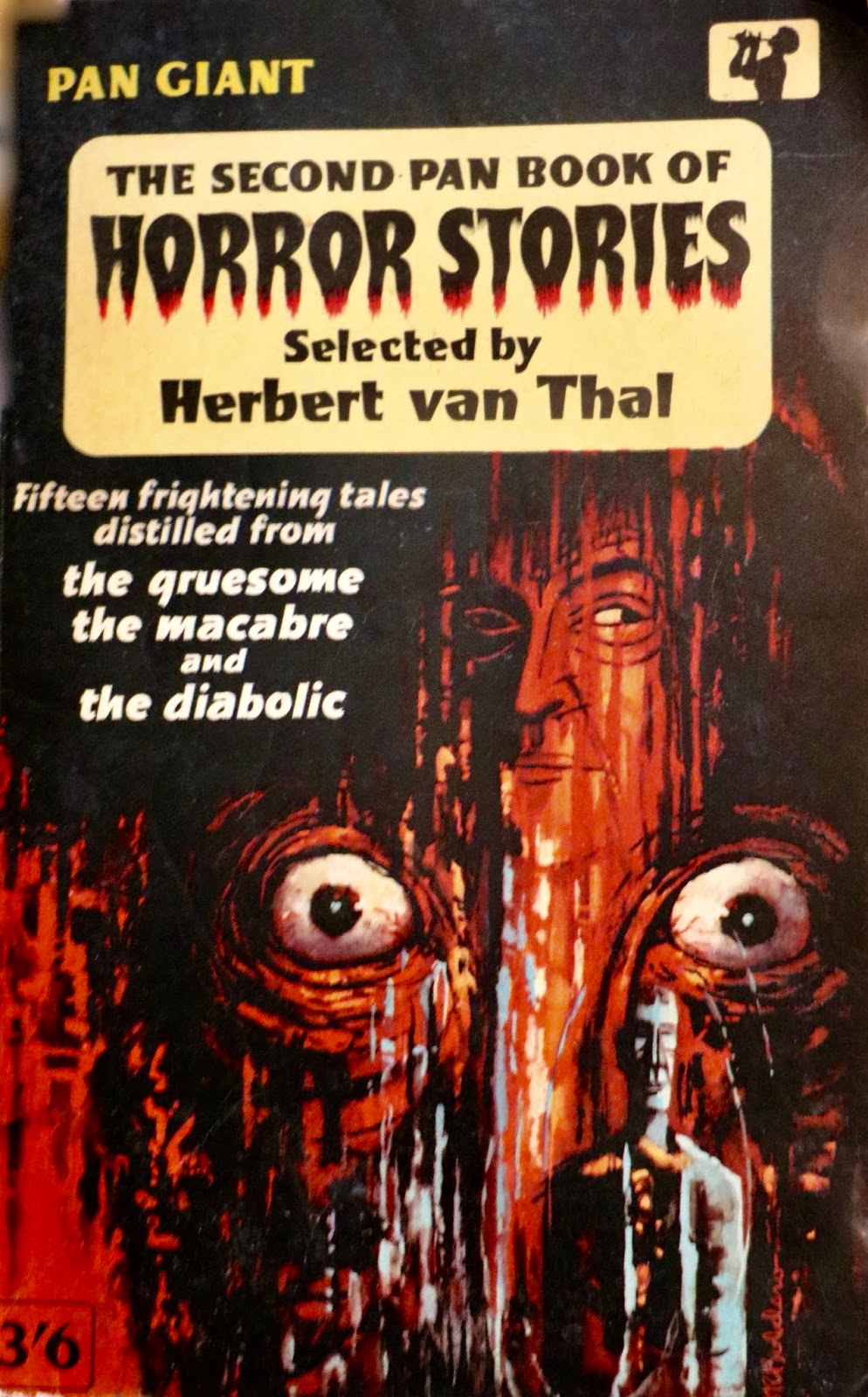
I have wanted to add some copies of The Pan Book of Horror Stories series to my library for some time. Recently I received volumes 1-3, 7  from a UK bookseller and I was delighted with the wonderfully atmospheric covers. 


But I did not want to do a simple show and tell post. With everything that is going on I have not put together a more in-depth post for some time. However I did want to discuss at least one story from vol 1. "W.S." by L.P.Hartley. Hartley is possibly best remembered today for the quote, “The past is a foreign country; they do things differently there.” from his novel The Go-Between. However he wrote a number of stories of interest to weird fiction fans. Many were collected in the Arkham House collection, The Travelling Grave and Other Stories. "W.S." does not appear in this collection. But it has been reprinted a number of times including an appearance in The Magazine of Fantasy and Science Fiction, August 1952, which can be located at The Luminist Periodical Archives, Science Fiction, Fantasy and Weird Fiction (link below). "W.S" is the story of the novelist Walter Streeter who begins to receive a series of rather cryptic postcards signed only W.S.. While they seem somewhat enigmatic, they do include rather pointed questions about his work and how it can be seen as a reflection on his personality. The horror here is not overt but rather understated, possibly more modern than much of the pulp style fiction of the era including other work by Hartley that I have read. If I could make a comparison I would suggest some glancing similarities to the work of the brilliant writer Jonathan Carroll who I heartily recommend. 

 http://www.luminist.org/archives/SF/


I procured vols. 8 and 12 in Calgary, some time ago, from the now sadly defunct Cabin Fever Books but the covers just do not have the same cache for me. One problem is I just do not like covers utilizing photographs as much. 


I have also been reading the posts and ogling the covers on Uncle Doug's Bunker of Vintage Horror Paperbacks. The site does not appear to have been updated since 2015 but since nothing on it is remotely time sensitive it is still fun viewing for fans of the the paperbacks of this era. 

"Hi! This is my attempt at starting a small blog about, what is in my eyes, the golden age of Horror Anthology Paperbacks and a huge passion of mine. Update: I've realized that what is even more important is the people have to be made aware of these wonderful stories before they disappear forever. Most the the stories I mention here haven't been reprinted in over 40 years and most likely will never been seen again. They will be lost to us once these books are gone and forgotten. How sad."

http://uncledougsbunkerofhorror.blogspot.com/

I do think the sheer number of books pictured on this blog, and the fact that my room and display space is filling up means that my collecting as such will slow down. 

Cover credits

Pan Book of Horror Stories, cover unattributed

Second, S. R. Boldero

Third, W. F. Phillipps

Seventh, cover unattributed

Eighth, cover unattributed

Twelfth, cover unattributed  

Thursday, February 20, 2020

NewNew Eldritch Tomes, Richard Powers, Robert Bloch, Fritz Leiber

Anyone who has followed my blogs will know that science fiction and weird tale/horror illustration is an area of real interest to me. I also love the slim horror anthologies and collections that appeared in the 1950's/1960's/1970's. So I could not resist these especially as Bloch and Leiber were part of Lovecraft's circle and fine writers in their own right. I have not been able to identify the cover artist of The Living Demons, isn't it lovely. But the rest are by Richard Powers, in a class by himself yet again. I have provided links below to other posts featuring Powers covers. I also enjoy seeing the advertisements on the back with other titles I might look for. I would love to know which is your favourite cover. Please enjoy. 


Not a new arrival but when I saw Invisible Men included both Basil Davenport as editor and Richard Powers as cover artists I had to include it. 


Pervious links to Powers Covers.

https://dunwichhorrors.blogspot.com/2016/04/horror-anthologies-and-art-of-richard.html

https://dunwichhorrors.blogspot.com/2016/05/horror-anthologies-art-of-richard.html

https://dunwichhorrors.blogspot.com/2016/05/horror-anthologies-art-of-richard.html